

Quick Summary
The best chef knife for small hands is one that fits your grip, not necessarily the smallest knife. Look at handle diameter, weight, and balance point, then run a simple at-home fit test. An 8-inch blade with a comfortable handle can work well, while shorter blades offer more control for precise cuts.
- Handle diameter and balance matter more than total knife length for small hands.
- Measure handle circumference by wrapping a tape around the thickest part of the handle.
- Match the balance point to your grip: forward for a pinch grip, behind the bolster for a handle grip.
- Check that your knuckles clear the cutting board by at least a finger's width during a chop.
- Shorter, lighter blades reduce wrist strain during long prep sessions.
Table of Contents
- Why Hand Size Changes the Right Chef Knife
- Chef Knife Size Guide: Choosing a Blade Length
- Chef Knife Handle Ergonomics and a Simple At-Home Fit Test
- How to Hold a Chef Knife Comfortably
- Weight, Balance and Wrist Comfort
- Chef Knife vs Santoku: Which Suits Smaller Hands
- Choosing Your Small-Hand Chef Knife at SiliSlick®
- Frequently Asked Questions
Why Hand Size Changes the Right Chef Knife
Choosing a chef knife for small hands is less about finding a "small" knife and more about finding one that fits your grip, your reach and your cutting style.
Many home cooks assume they need a tiny knife. Often that's not true. The handle diameter, the weight, and the blade length all matter more than total hand size alone.
A common mistake is buying based on looks alone. The rainbow titanium coating or Damascus pattern may catch your eye, but the knife has to feel right in your hand first.
Chef Knife Size Guide: Choosing a Blade Length
Blade length is the first decision to make. The most common chef knife length is 8 inches, and it's the one most cooks start with.
Here's a quick way to think about it:
| Blade Length | Best For | Control Level |
|---|---|---|
| 6 to 7 inches | Delicate tasks, tight spaces | High |
| 8 inches | All-purpose cooking | Balanced |
| 9 inches and up | Large vegetables, big batches | Lower for small hands |
The Damascus VG10 Chef Knife - Hammered Blade has an 8-inch blade and is designed for multipurpose kitchen use. You can see the Damascus VG10 Chef Knife in our shop to compare its blade length with your current knife.

Longer blades aren't automatically better. A longer knife requires a bigger sweeping motion, which can add wrist strain over time. Shorter blades let you keep your elbow closer to your body and your cuts more controlled.
Chef Knife Handle Ergonomics and a Simple At-Home Fit Test
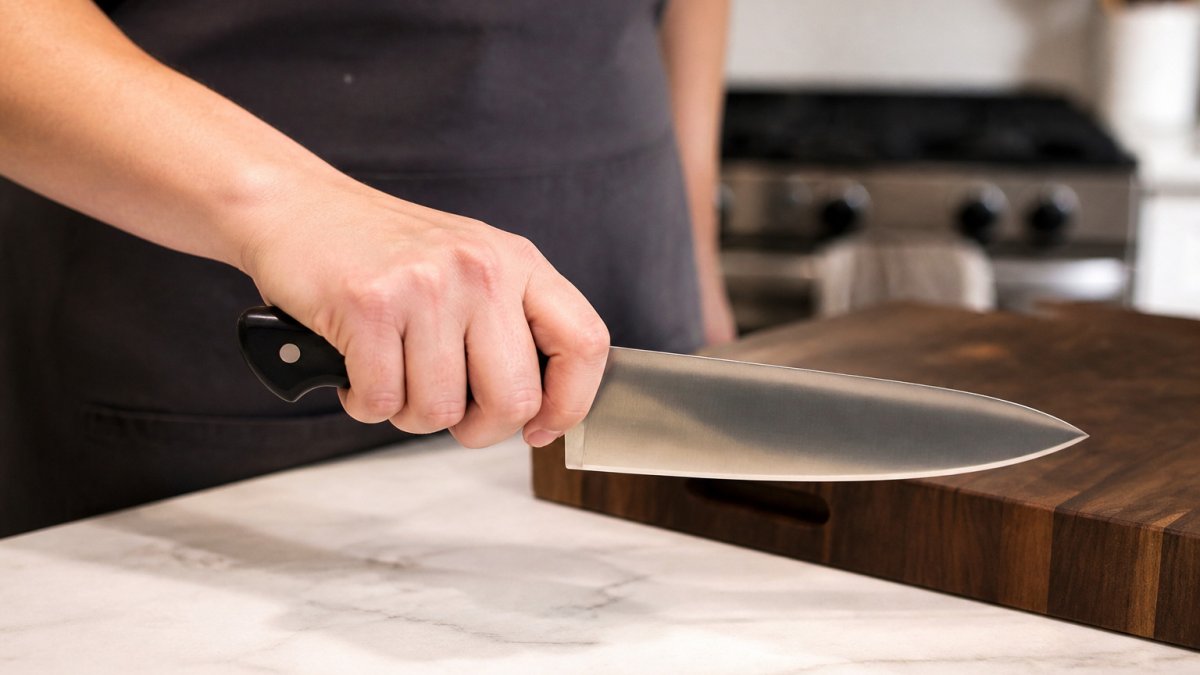
Handle ergonomics is where most small-hand buyers get lost, because "comfortable" is not a measurement. The fix is to check four concrete dimensions against your own grip: handle diameter (circumference), handle length, handle shape (oval vs. round vs. contoured), and knuckle clearance above the cutting board. The only reliable test is your own hand. Matching your knife to your palm size is the first step toward broader ergonomic kitchen design that reduces strain during long prep sessions.
Measure Handle Diameter and Length
Wrap a soft measuring tape around the thickest part of the handle you currently own, or around a rolled towel that matches the handle you are considering. Note the circumference. Then measure the usable handle length from the bolster to the butt. A handle that is too long forces your hand toward the blade; one that is too short leaves your pinky hanging off the end.
Check Handle Shape Against Your Grip
Most cooks use one of two grips. The pinch grip holds the blade where it meets the handle, with your thumb and index finger pinching the spine. The handle grip wraps your whole hand around the handle. Both are valid, but your handle choice should support whichever grip feels natural to you.
- Pinch grip: You need a handle that is not too thick at the front, so your thumb and index finger can reach the blade spine without stretching. A contoured or oval handle with a slight forward taper often works better than a fat round handle.
- Handle grip: You need a handle long enough for all four fingers and a shape that fills your palm without pressure points. A round handle can roll; an oval or D-shaped handle gives you a consistent reference.
The Damascus VG10 knives have Pakkawood handles, which offer resistance to moisture and an ergonomic grip for extended use. Compare handle designs and fit options before you choose.
Run a Structured At-Home Fit Test
Instead of a vague "hold it and see," run these four checks in order. They take about five minutes and let you compare knives consistently.
- Grip check: Hold the knife in your dominant hand using your normal grip. Your fingers should wrap without your thumb and index finger straining to meet. If you feel pressure at the base of your thumb or along your palm, the handle is too thick.
- Knuckle clearance check: Place the knife flat on a cutting board with the edge down and your hand on the handle. Your knuckles should clear the board by at least a finger's width when you make a simulated chop. If they graze the board, the blade is too tall or the handle sits too low for your hand.
- Control check: With the knife in hand, make small circular and up-and-down motions over the board. The knife should feel like an extension of your hand, not a tool you are fighting. If the tip wanders, the balance is off.
- Balance check: Rest the knife on your index finger at the point where the blade meets the handle. If the blade tip dips noticeably, the knife is tip-heavy for your hand. A neutral balance point at the bolster is easier to control for most small-hand cooks.
How to Hold a Chef Knife Comfortably
Good grip technique makes a bigger difference than most people expect. Start by holding the handle with your dominant hand, then place your index finger on the side of the blade near the bolster. Your thumb and other fingers wrap around the handle.
Follow these steps for a comfortable hold:
- Grip the handle firmly but not tightly.
- Rest your index finger on the blade's spine for control.
- Keep your wrist straight, not bent.
- Use your non-dominant hand to guide the food with curled fingertips.
Watch out: gripping too tightly is the most common mistake. See how to keep kitchen knives sharp so the blade needs less force to cut. A tense grip tires your hand quickly and makes the knife harder to control. Relax your fingers and let the knife's weight do the work.
Know Your Knife Lineup
- Damascus VG10 Chef Knife - Hammered Blade: about 8 inches, a good all-purpose choice.
- Damascus VG10 Santoku Knife - 7.25" High Carbon Japanese Blade: a shorter, lighter option.
- Damascus VG10 Steel Santoku Knife Classic Wave: a compact santoku with a wave pattern.
Weight, Balance and Wrist Comfort
Weight and balance affect wrist comfort more than almost anything else, but the right balance point depends on your grip. A pinch grip puts your hand forward on the blade, so a knife that is slightly blade-heavy can feel steady. A handle grip puts your hand back on the handle, so a neutral or slightly handle-heavy knife often feels more controlled. The only way to know is to measure the balance point and match it to your grip.
Find the Balance Point
Lay the knife across your index finger and slide it until the knife is level. Mark that point. On most chef knives, the balance point sits somewhere between the bolster and the first inch of the blade.
The Damascus VG10 Chef Knife weighs about 250 grams, or 8.8 ounces. Learn how to care for Damascus steel so its balance and edge hold up over time. Heavier knives can work well if you have strong wrists, but lighter knives generally reduce fatigue during long prep sessions.
Damascus VG10 Chef Knife - Hammered Blade →
Match Balance to Your Grip
Use this quick comparison to decide which balance point to look for:
| Grip Style | Preferred Balance Point | Why It Helps |
|---|---|---|
| Pinch grip | At or slightly forward of the bolster | Your hand is already forward, so a little blade weight adds stability without wrist strain. |
| Handle grip | At or slightly behind the bolster | Keeps the blade from pulling your wrist down during long chopping sessions. |
If you are not sure which grip you use, hold the knife in each grip for 30 seconds and notice which one lets your wrist stay straight. That is your natural grip, and it should drive your balance choice.
Watch for These Signs of Poor Balance
Pay attention to these signs of poor balance:
- The blade tip dips noticeably when you rest the knife on one finger.
- Your wrist aches after 10 to 15 minutes of chopping.
- You find yourself gripping harder to keep the knife steady.
- The knife rotates in your hand during rocking cuts.
If you notice any of these, a lighter knife or a shorter blade may help.
If you notice any of these, try a lighter knife or a shorter blade.
Chef Knife vs Santoku: Which Suits Smaller Hands
A chef knife and a santoku knife are both all-purpose kitchen tools, but they differ in shape. A chef knife has a curved edge that rocks back and forth on the cutting board.
A santoku has a flatter profile and shorter length than a chef knife.
A chef knife still wins for rocking cuts, like mincing herbs in a quick motion. If you cook many foods, one good chef knife may be enough.
Try the Damascus VG10 Santoku Knife - 7.25" High Carbon Japanese Blade if you want a shorter option. It's built for multipurpose use and has a Pakkawood handle.
Choosing Your Small-Hand Chef Knife at SiliSlick®
At SiliSlick®, we design knives for both style and performance.
Then pick the knife that feels most comfortable in your grip. You can shop the full Damascus VG10 range to find the size and style that works for you.

Frequently Asked Questions
Is an 8-inch chef knife too big for small hands? Not necessarily. An 8-inch knife with a comfortable handle and moderate weight can work well for smaller hands.
What is the best way to test a chef knife fit? Hold a similar-weight object like a rolled towel in your dominant hand and mimic a cutting motion.
Should I choose a chef knife or a santoku for small hands? Choose a santoku if you mostly slice and dice with straight-down cuts.
Frequently Asked Questions
What size chef knife is best for small hands?
For most small hands, an 8-inch chef knife is a common starting point, but many people with smaller hands find a 6- to 7-inch blade easier to control. The best size depends on how the knife feels in your grip, not just the blade length. Hold the knife with your normal pinch or handle grip and make a few slicing motions on a cutting board. If your knuckles hit the board or your wrist feels strained, try a shorter blade. The SiliSlick Damascus VG10 Santoku Knife, at a 4.5-inch blade and $79.00, is one option to consider for a more compact feel.
Is an 8-inch chef knife too big for small hands?
An 8-inch chef knife is not too big for everyone with small hands, but it can feel awkward if your hand is smaller or your cutting style is delicate. Watch for knuckle clearance problems and wrist fatigue during longer prep sessions. A shorter blade gives more control for precise tasks like mincing herbs. The SiliSlick Damascus VG10 Chef Knife has an 8-inch blade and weighs about 8.8 ounces, priced at $79.00, so test how it sits in your hand before deciding.
What handle shape is easiest to grip with small hands?
Pakkawood handles, like those on SiliSlick's Damascus knives, are ergonomic and resistant to moisture. Try gripping the handle in a few positions to see which one feels secure without strain.
What is the difference between a chef knife and a santoku?
A chef knife usually has a longer blade with a curved edge that supports a rocking cutting motion. A santoku has a shorter, flatter blade with a straighter edge, which many people find easier for chopping and slicing with an up-and-down motion. The SiliSlick Damascus VG10 Steel Santoku Knife, priced at $79.00, is a good example of a shorter blade for everyday prep.
