

Table of Contents
- What Makes a Kitchen Knife Durable Enough for Daily Use
- Full-Tang vs Partial-Tang Knives: Which Lasts Longer
- Quick Comparison: Top Durable Kitchen Knives
- 1. Damascus VG10 Steel Santoku Knife Classic Wave
- 2. Damascus VG10 Chef Knife - Hammered Blade
- 3. Kitchen Knife Set Kit with Magnetic Rack & Sharpener
- How to Maintain Kitchen Knife Sharpness for Years
- Essential Kitchen Knife Set for Beginners: What to Buy First
- Frequently Asked Questions
Last Updated: October 4, 2026
What Makes a Kitchen Knife Durable Enough for Daily Use
Durable kitchen knives for daily use share three things: a hard, corrosion-resistant steel core, a handle that stays secure when wet, and a blade geometry built for repeated cutting rather than occasional display.
Steel is where durability starts. Most kitchen knives fall into two broad families, and the difference matters more than any marketing claim on the box.
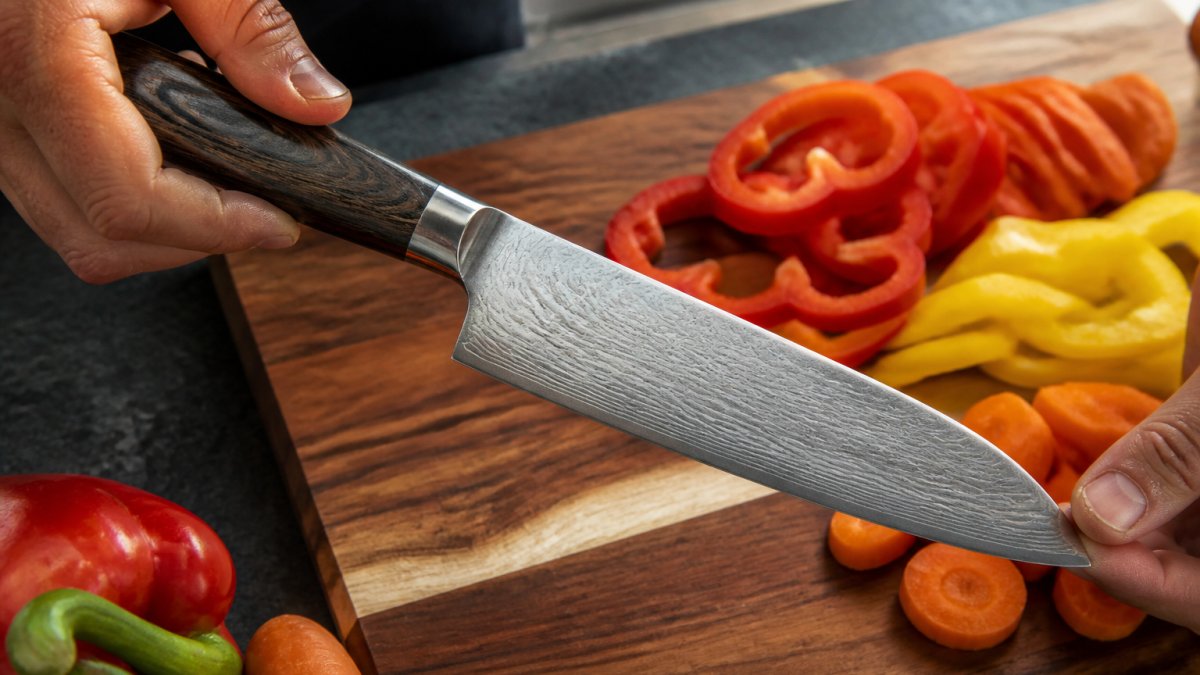
High-carbon stainless steel combines carbon for hardness with chromium for corrosion resistance.
Steel Type and Edge Retention
Edge retention is how long a blade keeps a usable cutting edge before it needs honing or sharpening. Two numbers drive it: the steel's hardness and the blade's geometry.
Hardness is measured on the Rockwell C scale. Our Damascus VG10 knives carry a core rated at 62+ Rockwell Hardness, which puts them in the range where a blade resists rolling and dulling through months of vegetable prep.

Geometry matters just as much. A thin, acutely angled edge cuts beautifully but chips when it hits a chicken bone. Our blades are double beveled at 12-18 degrees per side, a middle ground that stays sharp without becoming fragile.
Handle Material and Grip Comfort
A durable blade on a failing handle is still a failing knife. Handle material decides whether the knife survives moisture, heat, and thousands of grips.
Pakkawood, which we use on our Damascus knives, is a resin-impregnated hardwood laminate. It resists moisture, will not swell or crack the way untreated wood can, and keeps a warm, secure feel even with wet hands.
Grip comfort is not cosmetic. A handle that forces your wrist into an awkward angle makes you grip harder, and a hard grip is how most home cooks end up with a tired hand and an unsteady blade.
Full-Tang vs Partial-Tang Knives: Which Lasts Longer
Full-tang knives last longer in daily use. A full tang runs the steel from the tip of the blade all the way to the butt of the handle, so the metal and handle move as one piece. A partial tang stops partway into the handle, saving weight and cost but concentrating stress at the point where the steel ends.
Here is the practical difference:
| Feature | Full-Tang | Partial-Tang |
|---|---|---|
| Structural strength | Highest, steel runs handle-length | Moderate, stress point mid-handle |
| Balance | Forward-weighted, natural rocking motion | Handle-heavy, lighter feel |
| Handle security | Riveted through solid steel | Depends on adhesive and fit |
| Weight | Heavier | Lighter |
| Best for | Daily prep, heavy chopping | Light tasks, occasional use |
For anyone cooking most days, full-tang construction is the safer bet. The trade-off is weight, and some cooks prefer a lighter knife for quick tasks like trimming herbs.
Quick Comparison: Top Durable Kitchen Knives
Every knife below comes from our own line, so you can compare construction, steel, and price side by side before choosing.
| Knife | Steel | Blade Length | Price | Best For |
|---|---|---|---|---|
| Damascus VG10 Santoku Knife Classic Wave | 67-layer VG10 Damascus | 4.5 in | $79.00 | All-purpose daily prep |
| Damascus VG10 Chef Knife, Hammered Blade | 67-layer VG10 Damascus | 8 in | $79.00 | Slicing, dicing, mincing |
| Kitchen Knife Set Kit with Magnetic Rack & Sharpener | Stainless steel | 3.5-8 in | $28.00 | Beginners outfitting a kitchen |
1. Damascus VG10 Steel Santoku Knife Classic Wave
Our top pick for daily use is the Damascus VG10 Steel Santoku Knife Classic Wave.

The blade is built from 67 layers of VG-10 Damascus stainless steel around a high-carbon core rated at 62+ Rockwell Hardness. That layering is not just for looks.
What works: The 4.5-inch blade and roughly 7-inch total length make it nimble enough for herbs and sturdy enough for squash. The 12-18 degree double bevel slices cleanly without feeling fragile.
Where it falls short: It ships in a gift box with no sharpener or sheath, so you will want a honing rod or stone from day one.
Guide to knife safety and care
2. Damascus VG10 Chef Knife - Hammered Blade
If you want one knife that does everything, the Damascus VG10 Chef Knife with a hammered blade is the one we reach for most.
This is the heavier of our two Damascus knives at roughly 8.8 ounces, with an 8-inch blade. That extra length and weight make it the better choice for slicing roasts, breaking down poultry, and working through a pile of onions.
What works: The hammered finish genuinely reduces sticking, and the forward weight does part of the cutting work for you.
Where it falls short: At 8.8 ounces, it tires some cooks during long sessions. If you have small hands or prefer lighter tools, the Santoku is the friendlier option.
Damascus VG10 Steel Santoku Knife Classic Wave →
3. Kitchen Knife Set Kit with Magnetic Rack & Sharpener
For anyone starting from zero, the Kitchen Knife Set Kit with a magnetic rack and sharpener covers the essentials in one purchase.
The set also solves two problems beginners usually overlook: storage and sharpening. The magnetic rack keeps knives off the counter and safely displayed, and the included sharpener means you can maintain an edge without buying separate equipment.
What works: Everything you need to start cooking daily is in one box, and the non-stick titanium coating makes cleanup quick.
Where it falls short: These are stamped blades, not forged Damascus.
How to Maintain Kitchen Knife Sharpness for Years
Most guides stop at "hone often, sharpen rarely." That advice is correct but useless without the mechanism behind it. Here is what is actually happening to your edge, and how to keep a knife cutting well for five years or more.
Honing vs. Sharpening: Two Different Jobs
A knife edge is a microscopic wedge of steel. During normal cutting, that wedge bends and folds to one side rather than wearing away. Honing is the act of pushing the folded edge back into alignment with a rod or ceramic steel. It removes almost no metal. Sharpening is the act of grinding away steel to carve a fresh wedge when the edge has genuinely worn down or chipped.
A simple field test: if a few passes on a honing rod restore the bite, the edge was only misaligned. If honing does nothing, the edge is worn and needs sharpening.
How Often, Based on Steel Hardness
Frequency depends on the steel, not the calendar.
- Harder cores (roughly 60+ Rockwell C, like VG-10): hone every 2-3 uses, sharpen every 6-12 months for a home cook.
- Softer stainless (most stamped sets, roughly 52-56 Rockwell C): hone every use, sharpen every 2-4 months.
- Carbon steel: hones beautifully and sharpens fast, but needs drying and a light oil film after every wash to prevent staining.
If you cook daily, a hard-core knife typically needs a full sharpening once or twice a year. A soft stamped blade may need it four to six times.
The 15-Degree Rule
Most Western factory edges are set at 20 degrees per side. Most Japanese-style blades, including VG-10 Damascus, are set at 12-18 degrees per side. If you sharpen a 15-degree blade at 20 degrees, you grind away the acute edge and the knife will never feel sharp again until it is re-profiled. Match your sharpening angle to the factory angle, or use a guided system that holds it for you.
What Not to Do: Tasks That Destroy Durability
Durability is lost faster through misuse than through normal wear. These tasks will chip, roll, or snap an edge regardless of steel quality:
- Cutting frozen food. Ice is harder than most knife steel at freezer temperatures. A hard-core blade can micro-chip; a thin Japanese edge can snap.
- Bone-in meat and poultry joints. Twisting through a joint puts lateral force on an edge designed for slicing. Use a cleaver or kitchen shears.
- Hard squash and root vegetables with a thin blade. A 15-degree edge will wedge and roll. Use a heavier chef's knife and let the weight do the work.
- Glass and ceramic cutting boards. These are harder than knife steel and will dull any edge within a few sessions. Wood or plastic end-grain boards are the durable choice.
- The dishwasher. Heat, detergent, and rattling against other items dull edges and degrade handle adhesives. Hand wash and dry immediately.
- Leaving a carbon or Damascus blade wet. Even stainless Damascus cladding can stain at the exposed core. Dry before storage.
Storage That Protects the Edge
A knife that rattles against others in a drawer loses its edge to its own storage. Use a magnetic rack, a slotted block, or a blade guard. If you use a magnetic strip, place the knife spine-first so the edge never contacts the magnet.
Follow the honing schedule, sharpen at the correct angle, avoid the destructive tasks above, and a well-made knife will keep a working edge for years, not months.
Essential Kitchen Knife Set for Beginners: What to Buy First
An essential kitchen knife set for beginners needs three knives, not fifteen: a chef's knife or Santoku for most cutting, a paring knife for detail work, and a serrated bread knife for crusty loaves. Everything else is a bonus.
If you are outfitting a first kitchen, start with our full-tang Damascus Santoku or Chef Knife for your main blade, then add a set like the Kitchen Knife Set Kit for the supporting knives, storage, and sharpener.
Knife skills and safe cutting guidance
Durability is not about one feature. It is the steel, the tang, the handle, and how you treat the knife after the cutting stops. Get those four right and daily cooking stops being a fight with your tools.
Frequently Asked Questions
What is the best type of kitchen knife for everyday use?
A chef's knife or santoku knife handles most daily tasks. The Damascus VG10 Chef Knife from SiliSlick has an 8-inch blade and 62+ Rockwell Hardness, making it suitable for slicing, dicing, and chopping. Santoku knives work well for precision cutting. Both feature full tang construction and ergonomic handles for control during extended prep sessions.
What features make a kitchen knife durable?
Look for high-carbon stainless steel like VG10 with a Rockwell Hardness of 62 or higher, which resists dulling. Full tang construction adds balance and strength. A Pakkawood or slip-resistant polymer handle prevents moisture damage. Blade geometry and tapered edge design also affect how well a knife holds up to daily prep and repeated sharpening.
How do you maintain the durability of kitchen knives?
Hand wash with mild detergent and dry immediately to prevent corrosion. Use a honing rod regularly and sharpen at the correct angle, typically 12-18 degrees per side for Japanese knives. Store on a magnetic rack or in a sheath to protect the edge. Avoid dishwashers, which damage blade integrity and handle material over time.
What is a full-tang knife and why does it matter for durability?
A full-tang knife has steel running from the blade tip through the entire handle. This construction adds strength, improves balance, and prevents the blade from separating from the handle during heavy use. Partial-tang knives have less steel in the handle, which can weaken over time. For daily use, full-tang knives offer better long-term integrity.
Choosing durable kitchen knives for daily use means looking past the finish and asking what happens at month six, month twelve, and year three. At SiliSlick®, we build full-tang Damascus knives with 62+ Rockwell Hardness cores, moisture-resistant Pakkawood and polymer handles, and lifetime guarantees against manufacturing defects, so your knife keeps working as hard as you do. Explore our Damascus Santoku and Chef Knife or start with a complete set, and cook with tools that are built to last.