

Table of Contents
- Step 1: Hone Before Every Use to Realign the Edge
- Step 2: Choose Cutting Board Materials That Protect Your Blades
- Step 3: Wash and Dry Your Knives the Right Way
- Step 4: Store Knives So the Edge Never Touches Anything Hard
- Step 5: Know How Often to Sharpen Kitchen Knives
- Step 6: Stop Micro-Chipping and Rust Before They Start
- Step 7: Match Your Care Routine to Your Blade Material
- Common Mistakes That Dull Kitchen Knives Fast
- Frequently Asked Questions
Last Updated: September 27, 2026
Step 1: Hone Before Every Use to Realign the Edge
Learning how to keep kitchen knives sharp starts with a simple habit: run the blade across a honing steel before each use. Honing does not remove metal. It realigns the edge, which bends microscopically every time it strikes a cutting board.
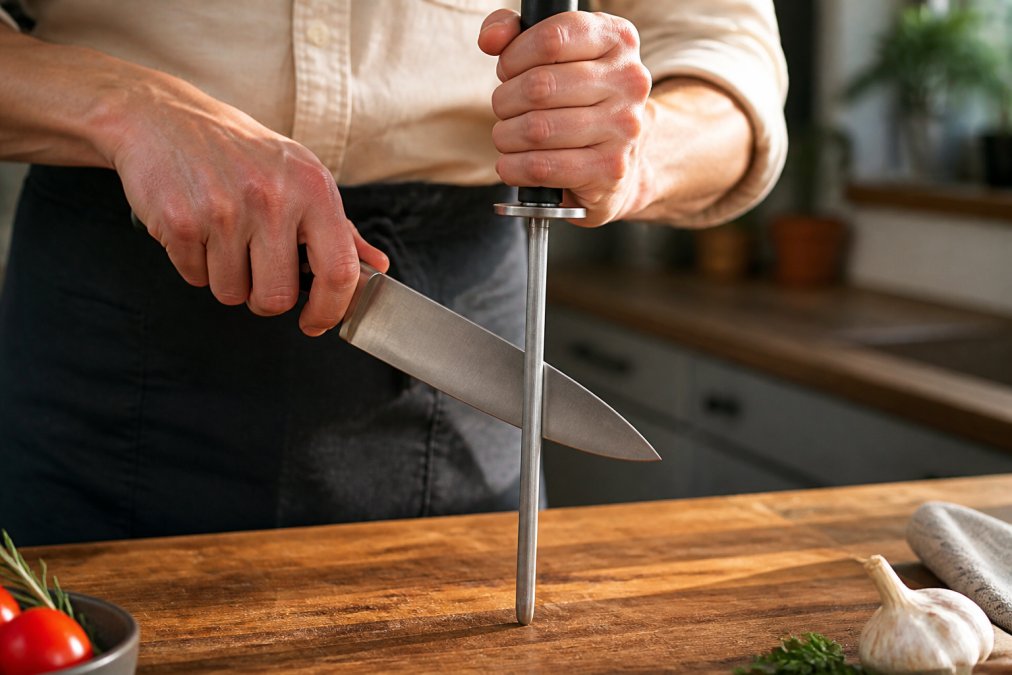
Setting the Right Honing Angle
Hold the honing steel point-down on a stable surface, or point-up if you prefer. Place the blade against the rod at roughly a 15 to 20 degree angle, about the width of two stacked coins between the spine and the steel. Draw the knife down and across in one smooth stroke, heel to tip, alternating sides four to six times.
Step 2: Choose Cutting Board Materials That Protect Your Blades
Bamboo deserves a caveat: it is harder than most woods and contains abrasive silica. If you own one, use it for vegetables and keep your good knives on wood or plastic.
Step 3: Wash and Dry Your Knives the Right Way
Hand washing is the only safe option for quality knives. A dishwasher exposes blades to high heat, harsh detergent, and tumbling against other items, corroding steel and chipping edges.
Step 4: Store Knives So the Edge Never Touches Anything Hard
Storage is where most edges quietly die. A crowded drawer lets blades knock against each other and metal utensils, producing nicks you will not notice until the knife starts tearing instead of slicing.
Three storage methods protect an edge:
- Magnetic strip or rack: holds knives blade-up, edge exposed to air only. SiliSlick's 5-Piece Titanium-Coated Kitchen Knife Set includes a magnetic rack that keeps all five knives separated and within reach.
- Edge guard or sheath: a plastic or felt-lined sleeve that covers the blade for drawer storage or travel.
- Knife block: works only if slots are sized to your knives; a loose slot lets the blade slide and strike the wood.
Step 5: Know How Often to Sharpen Kitchen Knives
Most home cooks need a full sharpening every two to three months with regular honing in between. Heavy daily use shortens that window; a knife used once a week can go six months. But the calendar is a rough guide, the real trigger is performance, and the fastest way to know is a two-minute diagnostic at the counter.

Diagnose the Edge Before You Sharpen
The paper test. Hold a sheet of paper vertically by one corner and draw the blade down through it, heel to tip, with light pressure and no sawing. A sharp edge slices cleanly with a faint zip; a dull edge tears, snags, or folds the paper; a chipped edge catches at one spot and skips.
Honing vs. Sharpening: Which One Do You Need?
Honing realigns a folded edge; sharpening removes metal to rebuild the bevel and apex. If honing restores performance for a day or two and then the knife fades again, the edge is worn, not just rolled, honing is polishing a rounded apex. That is the signal to sharpen.
Match the Method to the Blade
- Whetstone (water stone): the most control and the least metal removed per session. A 1000-grit stone handles routine sharpening; a 3000- to 6000-grit stone refines the edge afterward. Requires practice to hold a consistent angle.
- Electric sharpener: fast and repeatable, but most consumer units remove more metal per pass than a stone, so they shorten a blade's working life. Best reserved for inexpensive knives or heavy restoration.
- Pull-through sharpener: convenient, but carbide-blade versions gouge the edge and leave a rough, short-lived apex. Ceramic-wheel versions are gentler but still remove metal unevenly. Avoid carbide pull-throughs on any knife you care about.
- Professional sharpening: worth it once or twice a year for high-hardness or expensive blades, and the safest option if you are not confident holding an angle by hand.
Signs Your Knife Needs Sharpening, Not Just Honing
- The blade reflects light along its edge; a sharp edge is invisible because no flat surface catches the light.
- It slides off a ripe tomato instead of biting in.
- It crushes herbs rather than cutting them.
- It tears paper instead of slicing it.
- Honing no longer restores performance for more than a day or two.
If you see any of these, move past the honing steel and sharpen. And if the flashlight test shows a chip rather than a uniform roll, skip honing entirely, honing a chipped edge just rounds the chip further.
5-Piece Titanium-Coated Kitchen Knife →
Step 6: Stop Micro-Chipping and Rust Before They Start
Micro-chipping and corrosion are the two failures that end a knife's working life early, and both are preventable. Micro-chips come from lateral force: twisting the blade while cutting, chopping through bones or frozen food, or scraping food off a board edge-first.
Step 7: Match Your Care Routine to Your Blade Material
Blade steel determines how often you hone, sharpen, and oil. Treating every knife the same is why some edges last and others do not. The single number that explains most of the difference is hardness, measured on the Rockwell C (HRC) scale.
| Blade Material | Typical HRC | Edge Retention | Corrosion Risk | Care Routine |
|---|---|---|---|---|
| Carbon steel | 58-62 | High | High | Dry immediately, oil monthly |
| Stainless steel | 54-58 | Moderate | Low | Hand wash, hone weekly |
| Titanium-coated steel | 54-58 (core) | Moderate | Very low | Hand wash, avoid abrasives |
| High-hardness (HRC 60+) | 60-64 | Very high | Low | Hone gently, sharpen rarely |
Why Hardness Changes Everything
Harder steel holds an edge longer because it resists rolling and abrasion, but hardness trades against toughness. A blade at 60 HRC or above can take a razor apex and keep it for months, and can also chip under lateral stress that a softer blade would simply roll and recover from. Softer steel, around 54 to 56 HRC, rolls instead of chipping and is more forgiving for beginners, but needs honing more often.
A Maintenance Schedule by Steel Type
- Carbon steel (58-62 HRC): hone before each use, sharpen every four to eight weeks under daily use, dry within minutes of washing, and oil monthly. Carbon steel stains and rusts readily but takes a keen edge and is easy to sharpen.
- Stainless steel (54-58 HRC): hone weekly, sharpen every two to three months, hand wash and dry. The chromium content resists corrosion, but stainless is not rust-proof, prolonged moisture still pits the steel.
- Titanium-coated steel: treat the core like stainless, but protect the coating. Abrasive pads, dishwasher cycles, and pull-through sharpeners wear the coating down, and once it is gone the corrosion resistance goes with it. Hand wash, dry, and hone.
- High-hardness (60+ HRC): hone gently and infrequently, a few light strokes, and sharpen only when the paper test fails. Avoid pull-through sharpeners entirely; they remove too much metal and can chip a brittle edge. Consider professional sharpening once or twice a year.
Micro-Chipping: The Failure Hardness Makes More Likely
Micro-chipping is distinct from dulling. A dull edge has rolled or worn; a chipped edge has lost tiny fragments of steel along the apex, leaving a ragged line that catches on paper and tears rather than slices. Harder steel chips more easily, and the causes are almost always lateral: twisting mid-cut, chopping through bones or frozen food, scraping the board edge-first, or dropping the knife into a sink.
Environmental Factors Most Guides Ignore
Humidity and kitchen climate affect edge degradation more than most cooks realize. High humidity accelerates oxidation on carbon steel and on any blade where the coating has worn through, and storing knives near a dishwasher, sink, or stove exposes them to steam and heat cycles that speed corrosion. A dry drawer or a magnetic strip away from the sink beats a block next to the dish rack.
Common Mistakes That Dull Kitchen Knives Fast
The fastest way to ruin a good knife is a stack of small habits:
- Cutting on glass, ceramic, or stone surfaces.
- Leaving knives soaking in the sink.
- Running blades through the dishwasher.
- Scraping the board edge-first to move food.
- Storing knives loose in a crowded drawer.
- Using a pull-through sharpener with carbide blades, which gouges the edge.
- Skipping honing until the knife is fully dull.
Frequently Asked Questions
How do chefs keep their knives so sharp?
Chefs hone their knives before every shift, not after they feel dull. A honing steel realigns the edge in about 10 seconds, and most chefs sharpen on a whetstone or with a pull-through sharpener every 2 to 4 weeks depending on use. They also never cut on glass or stone, hand wash and dry immediately, and store knives on a magnetic strip or in a sheath so the edge never contacts metal or ceramic.
Should I use a honing steel or a whetstone?
They do different jobs. A honing steel realigns an edge that has rolled over from normal cutting, so use it before each cooking session. A whetstone removes metal to rebuild a worn edge, so reach for it every few weeks or when honing stops restoring sharpness. Skip pull-through sharpeners with carbide blades if you can; diamond rod sharpeners remove less metal per pass.
Why do my knives get dull so quickly?
Three habits dull a knife fastest: cutting on glass, ceramic, or stone surfaces, tossing knives into a dishwasher, and storing them loose in a drawer where edges knock against other tools. Bamboo and end-grain wood boards are gentler on edges. Hand washing with mild detergent and drying right away also prevents the corrosion and oxidation that weaken a thin edge over time.
What surfaces should I avoid cutting on to protect my blades?
Avoid glass, ceramic, marble, granite, and metal trays. These surfaces are harder than the blade steel, so the edge rolls or micro-chips on contact. End-grain wood and high-density plastic are the safest picks because they give slightly under the blade. If you use a bamboo board, keep cuts light; bamboo is denser than most woods and can wear an edge faster with heavy chopping.