

Table of Contents
- What Separates a Professional Knife Set From a Basic One
- Forged vs Stamped Knife Sets: Which Construction Lasts
- Essential Kitchen Knives for Home Chefs
- How to Sharpen Professional Kitchen Knives at Home
- Long-Term Maintenance Costs: What Most Buyers Miss
- Hand Size, Grip Ergonomics, and Handle Design
- Storage: Magnetic Strip vs Knife Block vs Modular Systems
- Conclusion
- Frequently Asked Questions
Last Updated: September 26, 2026
What Separates a Professional Knife Set From a Basic One
A professional knife set is built around full-tang blades, hardened steel, and balanced weight distribution rather than stamped blades with hollow handles. The difference shows in the first cut: a professional-grade chef knife falls through an onion under its own weight, while a budget blade requires pressure and sawing. This guide from SiliSlick® breaks down the steel grades, construction methods, and maintenance costs that separate a set you replace every two years from one you hand down.
Steel Quality and Rockwell Hardness Ratings
Rockwell hardness (HRC) measures how well a blade resists scratching and deformation. Most kitchen knives fall between 52 and 62 HRC. German-style stainless steel sits at 56-58 HRC, balancing edge retention against toughness. Japanese carbon steel reaches 60-62 HRC, holding a sharper edge longer but chipping more easily if you twist the blade.
Full Tang, Bolster, and Balance
A full tang means the steel runs the entire length of the handle, visible as a metal strip between the handle scales. Full-tang knives resist bending and balance better. The bolster is the thick metal collar between blade and handle; it adds weight forward and protects your fingers.
Forged vs Stamped Knife Sets: Which Construction Lasts
Forged and stamped knives start from different steel stock, and that difference cascades through weight, balance, edge geometry, and longevity.
How Each Blade Is Actually Made
A forged blade begins as a single bar or billet of steel. The manufacturer heats it to a plastic state, typically around 2,000°F for many stainless alloys, then shapes it under a drop hammer or press. That compression refines the grain structure and pushes material up into the bolster and down through the tang. The blade is then ground, hardened, tempered, and finished.
What the Construction Difference Actually Changes
- Weight and balance: A forged chef knife typically weighs 8-12 ounces and balances at the bolster. A stamped chef knife of the same length often weighs 4-7 ounces and balances toward the handle, feeling tip-light during rocking cuts.
- Edge geometry: Stamped blades are thinner behind the edge, slicing soft produce cleanly but flexing under hard squash or frozen food. Forged blades are thicker at the spine and taper gradually, giving more lateral rigidity.
- Bolster function: On a forged knife, the bolster is a forged-in finger guard and a pivot point for your pinch grip. On a stamped knife, a 'bolster' is often a separate collar that can loosen over years of washing.
- Sharpening life: A forged blade has more steel above the edge to grind away over decades; a stamped blade reaches the end of its usable life sooner.
- Price floor: Stamping is faster and cheaper to scale, which is why most sub-$80 block sets are stamped. Forging requires more labor, heat cycles, and finishing time, so forged sets start higher.
Where Stamped Sets Still Win
Stamped is not a defect. A well-made stamped knife is lighter, easier to control for smaller hands, and cheaper to replace; from a reputable maker it can last years with regular honing. The failure mode is a stamped blade sold at a forged price, or one with a hollow, glued handle that cracks after a year of dishwasher cycles.
A Quick Field Test Before You Buy
- Look at the spine. If steel runs the full length of the handle and is visible between the scales, it is full-tang. Solid plastic or wood with no visible steel is not.
- Check the bolster. A forged bolster is a smooth, continuous thickening of the steel; a stamped 'bolster' often has a visible seam or different finish.
- Weigh the balance. Pinch the blade at the bolster: a forged chef knife sits nearly level, while a stamped knife tips handle-down.
- Flex the tip. Light pressure flexes a stamped blade visibly; a forged blade of the same length feels rigid.
| Feature | Forged | Stamped |
|---|---|---|
| Starting stock | Single heated steel bar | Flat steel sheet |
| Grain structure | Refined by compression | As-rolled sheet |
| Typical chef weight | 8-12 oz | 4-7 oz |
| Balance point | At the bolster | Toward the handle |
| Bolster | Forged-in, structural | Thin, often separate |
| Edge retention | Longer | Shorter |
| Sharpening lifespan | Decades | Years |
| Best for | Daily cooking, heavy prep, whole proteins | Occasional cooking, lighter tasks, smaller hands |
Neither construction is a scam. The mistake is buying a stamped set at a forged price, or a forged set so heavy it tires your wrist before dinner.
Essential Kitchen Knives for Home Chefs
Most home cooks need four knives, not fifteen. A set built around the right core blades outperforms a larger block filled with tools you never touch.
The Core Four: Chef, Paring, Serrated, and Utility
- Chef knife (20-25 cm): Your workhorse for chopping, slicing, and dicing. If you buy one knife, buy this.
- Paring knife (7-10 cm): Peeling, trimming, and detailed work like hulling strawberries.
- Serrated bread knife: Cuts through crusty bread, tomatoes, and delicate pastries without crushing them.
- Utility knife (12-15 cm): The middle ground for sandwiches, cheese, and smaller proteins.
A santoku is a worthy alternative to the chef knife if you prefer a flatter profile for push-cutting vegetables. A slicing knife earns its place only if you carve roasts regularly.
How to Sharpen Professional Kitchen Knives at Home
Sharpening a professional kitchen knife at home takes a stone, a consistent angle, and about ten minutes per blade. Hold the blade at roughly 15-20 degrees, push it across the stone in a sweeping arc, and repeat on both sides until a burr forms along the edge.
Honing Rod vs Sharpening Stone: When to Use Each
A honing rod realigns a slightly rolled blade; use it before each cooking session, five to ten strokes per side. A sharpening stone removes metal to create a new edge; use it every two to three months, or when honing no longer restores sharpness. Confusing the two is the most common mistake home cooks make.
Long-Term Maintenance Costs: What Most Buyers Miss
Most knife-set guides stop at the sticker price. The real cost of ownership is the ten-year total: sharpening, replacement, cutting surfaces, and the small supplies that keep an edge alive. This is where a 'professional' set either earns its price or quietly bleeds money.
The Three Cost Buckets
1. Sharpening. You have three options, and they cost very different amounts over a decade:
- DIY on a whetstone. A quality combination stone (roughly 1,000/6,000 grit) costs $30-$80 and lasts years with flattening. Add a honing rod ($15-$40) and stone holder for a decade of sharpening under $150 total. The trade-off is time and a learning curve.
- Guided sharpening systems. Kits with angle guides and diamond or ceramic stones run roughly $50-$200, flattening the learning curve and producing repeatable angles, which matters on hard Japanese steel where a few degrees of error means a chipped edge.
- Professional sharpening services. Hardware stores, cutlery shops, and farmers markets sharpen knives for roughly $5-$15 per blade. A four-knife set sharpened twice a year at $10 per blade runs about $80 annually, roughly $800 over ten years, often more than the set itself cost.
A Rough Ten-Year Comparison
| Line Item | Budget Path | Quality Path |
|---|---|---|
| Initial set | $60 × 3 replacements = $180 | $200 once |
| Sharpening | Pull-through sharpener, $20 × 3 = $60 | Whetstone + rod, ~$100 once |
| Cutting boards | $15 plastic × 3 = $45 | $40 end-grain wood |
| Storage | In-drawer tray, $15 | Magnetic strip, $25 |
| Approx. 10-year total | ~$300 | ~$365 |
The totals are close. The quality path costs slightly more up front and over ten years, but you cook with better steel the whole time, avoid replacing a set mid-decade, and keep a tool that can be handed down rather than landfilled.
What Actually Drives the Cost Up
- Dishwasher cycles. Heat and detergent pit stainless steel and crack wooden handles. Hand-washing and immediate drying adds years to a set.
- Improper storage. A loose drawer dulls edges against other utensils; a magnetic strip or in-drawer organizer prevents micro-chipping.
- Skipping honing. Honing realigns a rolled edge before it becomes dull. Five to ten strokes per side before each session is the cheapest maintenance you can do.
- Sharpening too aggressively. Pull-through carbide sharpeners remove far more steel than a stone, shortening a knife's life and causing most premature replacements.
American Bladesmith Society glossary of blade terminology
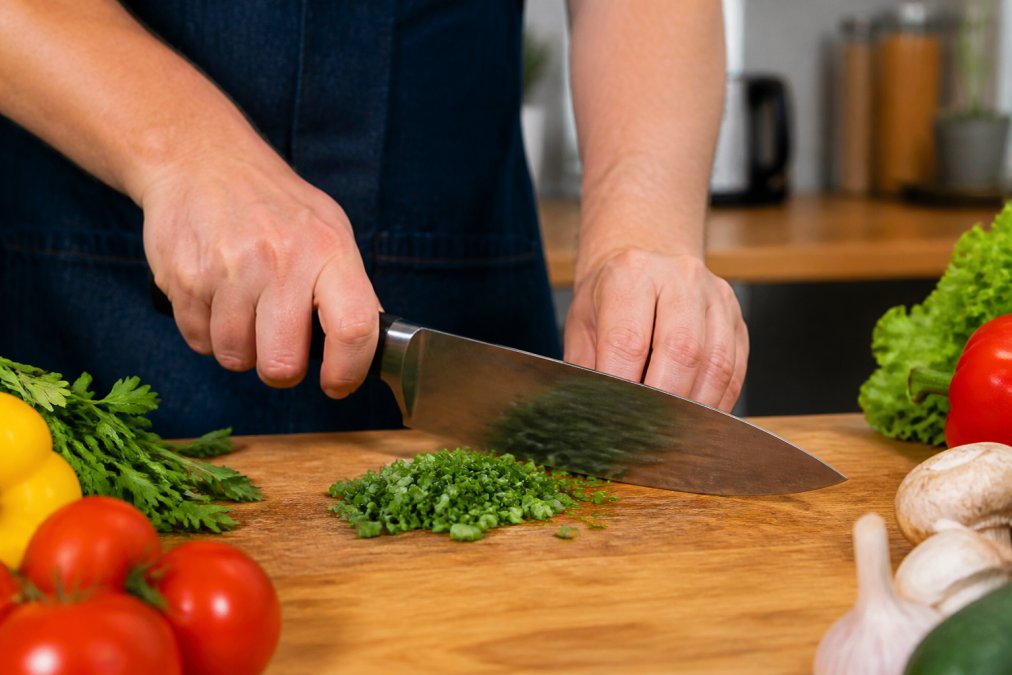
Hand Size, Grip Ergonomics, and Handle Design
Storage: Magnetic Strip vs Knife Block vs Modular Systems
Storage affects both edge life and counter space. A magnetic strip keeps blades visible, dry, and off the counter, but needs wall space and careful placement away from children. A knife block protects blades and looks traditional, though slots can trap moisture and dull edges. Modular systems let you add or remove knives as your collection changes.
| Storage Type | Space Use | Edge Protection | Best For |
|---|---|---|---|
| Magnetic strip | Minimal counter, needs wall | High, blades stay dry | Small kitchens, frequent cooks |
| Knife block | Takes counter space | Moderate, moisture risk | Traditional setups |
| Modular system | Flexible | High | Growing collections |
Conclusion
Choosing the best professional knife set for home comes down to three decisions: forged or stamped construction, steel hardness that matches how you cook, and a handle that fits your grip. Get those right and the set lasts years instead of months. At SiliSlick®, our full-tang knife sets pair rainbow titanium-coated stainless steel blades with Damascus etched designs, built for home cooks who want professional performance and a kitchen that looks the part.
Frequently Asked Questions
What knife sets do professional chefs use in their home kitchens?
Most professional chefs keep a compact set at home: an 8-inch chef knife, a paring knife, a serrated bread knife, and sometimes a santoku. They prioritize forged, full-tang blades with high carbon stainless steel for edge retention. Many chefs prefer building their home collection around three or four essential knives rather than buying a large pre-set block, since they use each blade more intentionally. A professional knife set for home use should match that same focus on quality over quantity.
What are the key differences between stamped and forged professional knife sets?
Forged knives are shaped from a single heated steel bar, creating a thicker bolster, a full tang, and better balance. Stamped knives are cut from a flat sheet of steel, making them lighter and less expensive but typically thinner. Forged sets generally hold an edge longer and resist bending, while stamped sets work well for lighter tasks. The forged vs stamped knife sets decision often comes down to budget and how much daily use you expect.
How do titanium-coated blades compare to traditional stainless steel for home use?
Titanium-coated stainless steel blades add a layer of scratch and corrosion resistance on top of the steel core, which helps with cleanup and keeps the blade looking new. The coating does not replace the need for honing or sharpening, but it can extend the time between maintenance sessions. Traditional uncoated stainless steel offers similar cutting performance, so the choice often comes down to aesthetics and how much you value easier cleaning.
What features should I look for in a professional-grade home knife set?
Focus on four things: steel type and Rockwell hardness (56-62 HRC is a solid range for home use), full tang construction for balance and durability, an ergonomic handle that fits your grip, and blade geometry suited to your cooking style. A chef knife, paring knife, and serrated bread knife cover most home tasks. If you cook daily, investing in forged construction pays off over time through better edge retention and fewer replacements.
Ready to upgrade from dull, mismatched blades? SiliSlick® builds full-tang knife kits with rainbow titanium-coated stainless steel blades, Damascus etched patterns, and ergonomic handles designed for control and comfort. Shop the SiliSlick® collection and give your kitchen cutlery the performance and style it deserves.