

Table of Contents
- Why Home Cooks Switch From ChefsVision
- Best Kitchen Knife Set for Home Cooks: What Matters Most
- How to Choose a Chef Knife: Key Selection Criteria
- Essential Knives for Home Cooking: Building Your Collection
- Knife Set Care and Maintenance: Keeping Blades Sharp
- Affordable Alternatives With Professional Performance
- The Value Proposition: What You're Really Paying For
- Frequently Asked Questions
Last Updated: October 18, 2026
Why Home Cooks Switch From ChefsVision
Home cooks often start with whatever knife set they inherit or grab on sale. A dull blade that requires twice the pressure. A handle that doesn't fit your grip. A set so large you use three knives and ignore the rest.
That's when the search for a better chefsvision alternative begins. The real issue isn't that your current knives don't work, it's that they force you to work harder. At SiliSlick®, we've designed kitchen knife sets specifically for home cooks who want professional performance without the professional price tag.

The best chefsvision alternative focuses on what actually matters: a sharp blade that holds its edge, a handle that fits your hand, and a design that makes you want to cook. Below, we'll walk you through how to find the set that matches your cooking style.
Best Kitchen Knife Set for Home Cooks: What Matters Most
Choosing the right kitchen knife set comes down to what separates a tool that sits in a drawer from one you reach for every day. The real difference lies in three core factors: blade material, edge retention, and how it feels in your hand.
A quality kitchen knife set doesn't need to be complicated. You need blades that cut cleanly, handles that won't slip when your hands are wet, and storage that keeps everything accessible. The Culinary Institute of America's kitchen fundamentals guide emphasizes that proper blade material directly impacts both cutting performance and maintenance requirements for home cooks.
Blade Material and Coating
Blade material determines how sharp it gets, how long it stays sharp, and how much maintenance it needs. Stainless steel is the practical choice for home cooks because it resists rust and requires less upkeep than high-carbon steel. A titanium coating adds a non-stick surface that helps food release cleanly and prevents rust buildup on the edge.
SiliSlick® uses iridescent titanium-coated stainless steel blades because the coating serves a real purpose: it reduces friction during cutting, speeds cleanup, and protects the blade from corrosion. When you hand wash your knives, the coating prevents rust spots where water sits.
High-carbon steel holds a sharper edge longer but requires immediate drying after washing. For most home cooks, that extra maintenance isn't worth it. A titanium-coated stainless blade gives you most of the sharpness with a fraction of the care.
Edge Retention and Cutting Performance
Edge retention is how long your blade stays sharp before it needs honing or sharpening. A blade that dulls after two weeks is frustrating; one that performs well for two months makes cooking genuinely easier.
Sharpening angle affects both sharpness and durability. A blade sharpened at 12-18 degrees per side (like the Damascus VG10 Steel Santoku Knife from SiliSlick®) stays sharper longer and handles tough tasks without chipping. A blade at 20+ degrees is easier to maintain but dulls faster.
What matters most is consistency. Your knife should cut through tomato skin without crushing the flesh, slice raw chicken without sawing, and mince herbs without bruising them. If your current knife can't, the blade material needs attention.
How to Choose a Chef Knife: Key Selection Criteria
Choosing a chef knife means understanding your cooking habits first. Do you prep vegetables daily? Break down whole chickens? Work quickly or methodically? Your answers determine which blade length and shape fit your workflow.
A proper chef knife selection starts with honesty about what you'll actually use. The National Association of Culinary Professionals notes that most home cooks use only three knife types regularly, regardless of set size.
Blade Length and Shape for Your Cooking Style
An 8-inch chef knife is the standard for a reason: long enough for large vegetables and proteins, but not unwieldy on a home cutting board. A 7-inch blade works if you have smaller hands or limited counter space. A 6-inch blade is too short for efficient cutting.
Blade shape matters for specific tasks. A Western chef knife has a curved edge that rocks on the board; a Japanese-style santoku has a straighter edge for push-pull cutting. Both work; the difference is technique.
For home cooks, an 8-inch chef knife handles 80% of cutting tasks. A santoku helps with precise vegetable work, a serrated bread knife is essential for crusty bread, and a paring knife handles peeling and detail work. That's all most home cooks need.
Handle Comfort and Control
Your handle should feel secure when your hands are wet, balance the blade weight so the knife doesn't pull your wrist down, and stay comfortable through 15 minutes of continuous chopping.
Ergonomic handles matter more than they sound. A poorly balanced knife forces your hand to work harder, causing mistakes and fatigue. A well-designed handle, like those on SiliSlick® knife sets, distributes blade weight evenly so the knife does the work, not your wrist.
Test grip by holding the knife as you would while cutting: thumb and index finger wrap around the blade just above the handle, remaining fingers grip the handle. If it's too thick or thin, you'll know immediately. If it's right, you'll forget you're holding it.
Essential Knives for Home Cooking: Building Your Collection
Most home cooks don't need a 12-piece set. You need five knives that cover every cutting task; more creates clutter rather than capability.
Start with these five essentials:
- 8-inch chef knife: Your workhorse for chopping, slicing, and dicing vegetables, meat, and herbs
- 8-inch bread knife: Serrated edge for slicing bread, tomatoes, and other delicate items without crushing them
- 7-inch santoku: Precision blade for detailed vegetable work and thin slicing
- 5-inch utility knife: Medium blade for tasks between paring and chef knife work
- 3.5-inch paring knife: Small blade for peeling, deveining, and intricate detail work
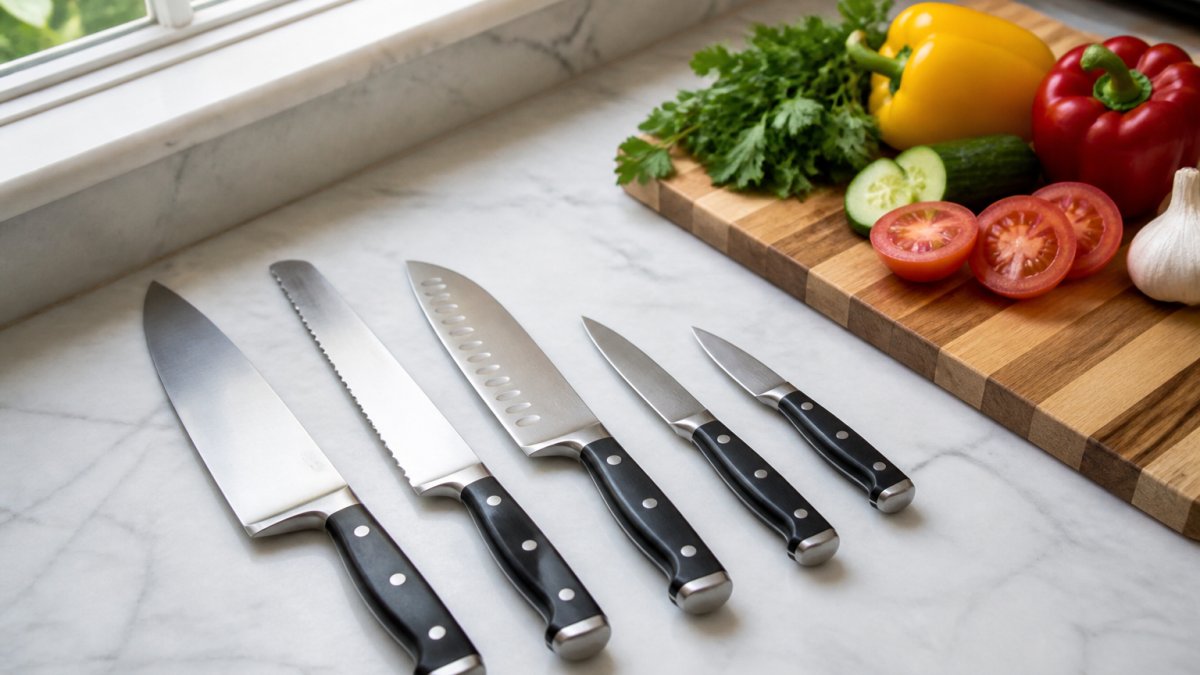
The SiliSlick® 5-Piece Titanium-Coated Kitchen Knife Set with Magnetic Rack includes all five knives, plus a magnetic rack for organized storage and a sharpener. No more hunting through drawers, and every knife stays sharp and accessible.
Chef Knife vs. Santoku vs. Utility Knife
These three blades cover most cutting needs but excel in different situations. Knowing when to reach for each makes cooking more efficient.
5-Piece Titanium-Coated Kitchen Knife Set with Magnetic Rack →
A chef knife is your default for 70% of cutting tasks. The curved blade rocks on the board for a smooth, rhythmic motion and handles everything from delicate herbs to tough root vegetables.
A santoku is a precision tool for clean, thin slices. Its straighter blade makes uniform vegetable pieces easier. If you do a lot of meal prep with consistent sizing, it becomes your favorite knife.
A utility knife fills the gap between paring and chef knife: slicing a single chicken breast, halving a bell pepper, trimming fat.
Most home cooks reach for their chef knife 80% of the time. The santoku and utility knife handle the remaining 20%.
Knife Set Care and Maintenance: Keeping Blades Sharp
A sharp knife requires less maintenance than a dull one. A dull blade needs more pressure, which damages the edge and makes the knife harder to control. A sharp blade slices cleanly with minimal pressure.
Hand washing is non-negotiable. A dishwasher exposes blades to harsh detergents and metal-on-metal contact that dulls them quickly. Hand wash with mild detergent, dry immediately, and store properly.
Sharpening frequency depends on use; home cooks typically sharpen every 3-6 months. A portable sharpener like the one included in SiliSlick® sets makes this quick and simple.
The American Culinary Federation's blade maintenance standards recommends honing (realigning the blade) weekly and sharpening (removing dull metal) every 2-3 months for regular home use.
Affordable Alternatives With Professional Performance
The best chefsvision alternative doesn't require spending hundreds of dollars. It requires choosing a set designed for home cooks rather than professional kitchens.
SiliSlick® knife sets start at $29.00 for a complete 5-piece set with magnetic rack and sharpener. That price is possible because we focus on what home cooks actually need rather than unnecessary specialty blades.
The quality difference between a $15 knife set and a $29 set is dramatic. The $29 SiliSlick® set uses titanium-coated stainless steel with proper blade geometry that stays sharp for months, plus ergonomic textured handles and an included magnetic rack.
For something more specialized, the Damascus VG10 Steel Santoku Knife from SiliSlick® costs $79.00 and offers professional-grade performance.
This knife excels at precision cutting. If you wish your current santoku held its edge longer or cut more cleanly, this blade delivers.
| Set | Price | Best For | What's Included |
|---|---|---|---|
| 5-Piece Titanium-Coated Set | $29.00 | Home cooks starting out | 5 knives, magnetic rack, sharpener |
| Damascus VG10 Santoku | $79.00 | Precision vegetable work | 1 santoku knife, gift box |
A complete knife set at $29.00 gives you professional performance without the professional investment: five properly designed blades, organized storage, and a sharpener, without specialty blades you won't use or features that inflate the price.
The Value Proposition: What You're Really Paying For
When you buy a knife set, you're paying for blade geometry, material quality, edge retention, handle ergonomics, and the thought that went into balancing all of these factors, not just metal and handles.
A cheap knife set saves money upfront but costs more over time. You replace it within a year, work harder because the blades are dull, and risk accidents when handles slip.
A quality knife set from SiliSlick® costs more initially but lasts for years.
Upgrading your kitchen knives transforms how you cook. The right set makes meal prep faster, safer, and genuinely enjoyable. SiliSlick® designs knife sets specifically for home cooks who want professional performance without professional complexity.
Frequently Asked Questions
What should home cooks look for in a ChefsVision alternative?
Home cooks should prioritize edge retention, comfort grip, and durability. Look for titanium-coated or high-carbon steel blades that hold sharpness through frequent use. A complete set with essential knife types, chef, santoku, utility, and paring knives, covers 95% of everyday kitchen tasks. Storage solutions like magnetic racks matter too, since organized knives stay sharper longer and are safer to access.
Do home cooks need a full knife set or just a few essential knives?
A focused set of five essential knives handles virtually all home cooking: an 8-inch chef knife for chopping and slicing, an 8-inch bread knife for even cuts through crusty loaves, a 7-inch santoku for precision dicing, a 5-inch utility knife for medium tasks, and a 3.5-inch paring knife for detailed work. This covers vegetables, meats, bread, and intricate prep without clutter or waste.
How should you care for coated kitchen knife blades?
Hand wash titanium-coated blades immediately after use with mild detergent and dry them right away. Never use a dishwasher, as heat and harsh detergents degrade the coating. Store knives on a magnetic rack or in protective sheaths to prevent dulling and corrosion. Use the included sharpener regularly to maintain edge performance, and avoid cutting on glass or marble surfaces that accelerate blade wear.
What knife features matter most for everyday meal preparation?
Sharpness, balance, and grip comfort rank first. A sharp blade reduces effort and accidents, you need less force, so the knife stays under control. Weight distribution between blade and handle prevents hand fatigue during extended prep. Ergonomic handles with slip resistance make chopping vegetables and meat safer and more efficient. A non-stick coating reduces food sticking, which slows you down and makes cleanup harder.