

Last Updated: October 26, 2026
Quick Summary
A blue handle kitchen knife set comparison should start with blade steel, not color: look for full-tang construction, 56-58 HRC hardness, and a 15-20 degree edge per side. Handle material and fit decide comfort, while a five-knife set covers nearly every home task.
- Most home cooks get the best balance at 56-58 HRC, hard enough to hold an edge but tough enough to survive handling.
- Full-tang blades add balance and reduce the chance of the handle separating from the steel.
- A complete home set needs five knives: chef, bread, santoku or utility, utility, and paring.
- The wet-hand grip test is the most under-tested variable in blue-handle comparisons.
- Resin and polymer composite handles hold blue color better than painted or dyed wood handles.
Table of Contents
- What Actually Separates One Blue Handle Knife Set From Another
- Blade Steel and Construction: The Core of Any Blue Handle Knife Set
- Blue Handle Material and Color Durability
- Handle Ergonomics Across Hand Sizes and Grip Styles
- Essential Knives for Home Cooks: What a Complete Set Includes
- Kitchen Knife Set With Block or Magnetic Rack: Storage and Accessories
- Knife Set Buying Guide: How to Judge the Best Kitchen Knife Sets
- Choosing Your Blue Handle Kitchen Knife Set
- Frequently Asked Questions
What Actually Separates One Blue Handle Knife Set From Another
A blue handle kitchen knife set comparison usually starts with looks, and that is the wrong place to begin. The handle color is the first thing you notice and the last thing that affects how a knife cuts. What separates a good set from a disappointing one is the steel under the coating, the geometry of the edge, and whether the handle still feels secure after a year of daily washing.
At SiliSlick®, we build full-tang sets with titanium-coated stainless steel blades, so we have a clear bias here. We also know what fails first in inexpensive cutlery: loose handles, chipped edges, and coatings that wear thin near the heel of the blade.
Below, we break down each factor that matters, from blade construction to storage, so you can judge any blue-handle set on the shelf. The kitchen knife set with blue handles we make is one reference point, not the only one worth considering.

Blade Steel and Construction: The Core of Any Blue Handle Knife Set
Blade steel decides how long an edge lasts and how well it resists rust, and the difference between a set that still cuts cleanly after three years and one that needs replacing after eighteen months usually comes down to two numbers: the steel grade and its Rockwell hardness.
Most blue-handle sets sold today fall into one of three steel families. The first is X50CrMoV15 (also sold as 1.4116 or "German steel"), a high-carbon stainless used by most mid-range European-style sets. It typically lands around 54-56 on the Rockwell C scale (HRC), which makes it tough and forgiving but means it needs honing more often. The second is VG-10 or a similar Japanese stainless, which runs harder at 60-61 HRC and holds an edge noticeably longer, but chips more readily if you twist the blade or cut through bone.
Harder is not automatically better. A 61 HRC blade that gets used on a bamboo cutting board and occasionally hits a sink will chip; a 55 HRC blade in the same hands will roll its edge instead, which is easier to fix with a honing rod.
Construction matters just as much. A full-tang blade runs the steel through the entire handle, which adds balance and reduces the chance of the handle separating from the blade over time.
Edge geometry is the third variable. Most Western-style sets ship with a 15-20 degree edge per side, which balances sharpness with durability. Asian-style blades often use a narrower 15-degree edge or a single-bevel grind, which cuts more aggressively but is less forgiving.
Then there is the finish. A titanium coating adds corrosion protection and creates that iridescent color, and it also gives the blade a non-stick quality that helps food release cleanly. The coating is not armor, though. It wears at the edge over years of honing, which is normal and does not affect cutting performance.
Our blue handle kitchen knife set uses titanium-coated stainless blades with full-tang construction, and we publish the steel grade and hardness on the product page so you can compare it directly against any other set on your shortlist.
Blue Handle Material and Color Durability
Handle color fades for predictable reasons: sunlight, hot water, and harsh detergents. A blue handle made from a resin or polymer composite holds color better than a painted wood handle, because the pigment runs through the material rather than sitting on top of it. To browse other colorful options and compare finishes, see our best colorful knife sets.
Watch for handles that show white stress marks near the rivets after a few months. That signals a cheap plastic that is flexing under load. Riveted handles distribute stress across the handle scales, which is one reason traditional construction persists. For more on how rivets affect durability and grip, read why knives have rivets in the handle.
Handle Ergonomics Across Hand Sizes and Grip Styles
A handle that fits one cook's hand can cramp another's. The variables are handle circumference, the taper from bolster to butt, and whether the material has any texture for grip when your hands are wet.
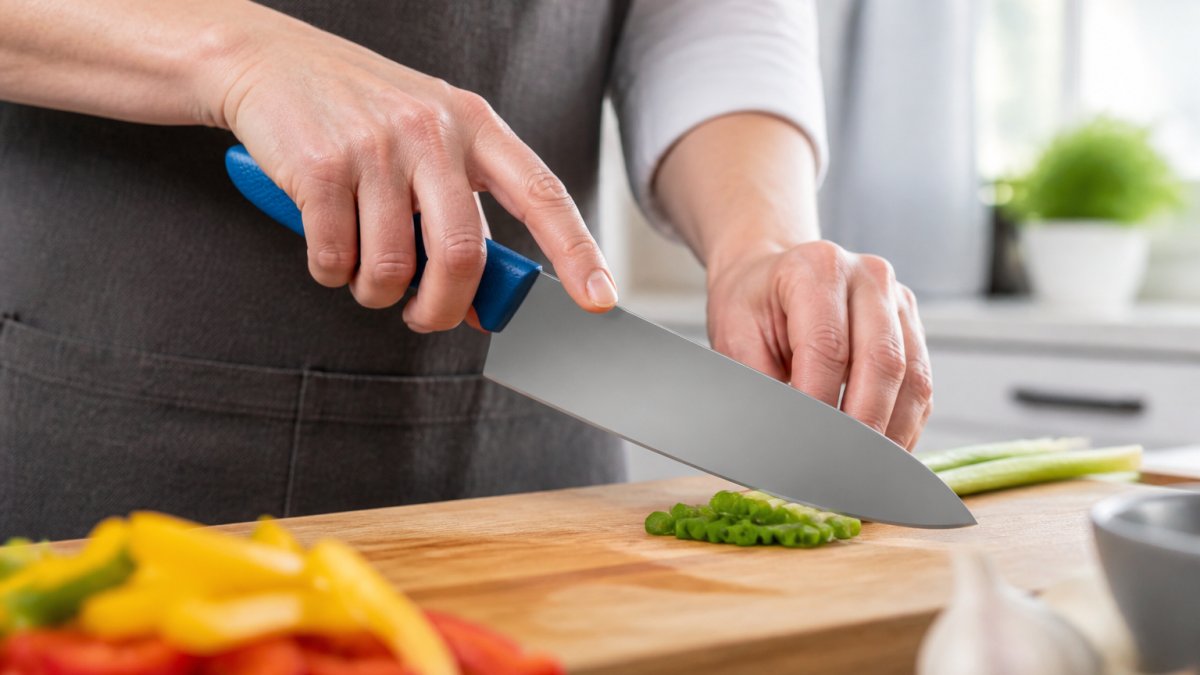
Smaller hands tend to do better with a slimmer handle and a pronounced finger guard, which keeps the hand from sliding forward. Larger hands often prefer a fuller handle with a slight swell in the middle. Either way, the test is simple: hold the knife in a pinch grip, with your thumb and index finger on the blade and the remaining fingers wrapped around the handle. If your wrist bends to keep the tip down, the handle is too thick.
Essential Knives for Home Cooks: What a Complete Set Includes
A complete set for most home kitchens needs five knives, not fifteen. The essentials are an 8-inch chef knife for most chopping, an 8-inch bread knife with a serrated edge, a santoku or utility knife for precision work, a 5-inch utility knife for medium tasks, and a 3.5-inch paring knife for detail work. Maintaining a firm grip on these essential blades becomes significantly easier when utilizing specialized kitchen tools for tremors to ensure safety and precision during every cut.
Anything beyond that is a bonus. Steak knives and kitchen shears are useful, but they are not what you reach for when dinner needs to be on the table. Sets that pad the count with duplicate sizes tend to leave half the block untouched.
Knife-by-knife completeness is one of the angles most comparisons skip. Count the knives you will actually use weekly, then check whether the set covers them before you look at the total piece count.
Kitchen Knife Set - Blue Handle →
Kitchen Knife Set With Block or Magnetic Rack: Storage and Accessories
Storage is where set design gets practical. A knife block protects edges and keeps knives within reach, but it takes counter space and the slots can trap moisture if you put knives away wet. A magnetic rack mounts to the wall, saves counter room, and lets blades air-dry, which is better for corrosion resistance.
Some kits bundle a rack and a sharpener, which removes two separate purchases. Our blue handle knife set kit with a magnetic rack and sharpener is built around that idea: five knives, a black magnetic rack, and a handheld sharpener in one box.

Whichever you choose, confirm the accessories match the knives. A rack that is too short for an 8-inch blade is worse than no rack at all.
Knife Set Buying Guide: How to Judge the Best Kitchen Knife Sets
Most buying guides tell you to check the tang, the steel, and the handle. For a deeper look at whether a pricier set is justified, see our value comparison of expensive knife sets.
1. The paper-and-tomato test (five minutes). Slice a ripe tomato with each knife using only the knife's weight, no downward pressure. A sharp, well-ground edge bites through the skin on the first pass. A dull or poorly ground edge slips.
2. The carrot-and-onion test (ten minutes). Dice an onion and slice a carrot into coins with each set's chef knife. Onion layers should separate cleanly without crushing; carrot coins should not crack or wedge.
3. The wet-hand grip test (two minutes). Wet your hands, then hold each knife in a pinch grip and make twenty cuts through a soft vegetable.
4. The edge-retention check (two weeks). Use one knife from each set as your daily chef knife for a week, honing only with a rod. At the end of the week, repeat the tomato test.
5. The handle-color durability check (one month). Wash each knife by hand daily and leave it to air-dry. After a month, inspect the handle near the rivets and along the spine for fading, white stress marks, or hairline cracks.
6. The set-composition audit (five minutes, no cooking). Lay every knife in the set on the counter and ask which ones you used in the last week.
Run those six checks and the weak sets fall away fast. A common mistake is paying for piece count instead of construction, twelve mediocre knives do less for you than five well-built ones. The second common mistake is judging a blue-handle set by its color in the box; the color is the last thing that changes, and the first thing that sells.
If you want to see how our blue handle knife set kit with a magnetic rack and sharpener performs against these six checks, the product page lists the steel grade, hardness, edge angle, and handle material so you can compare it line by line.
Choosing Your Blue Handle Kitchen Knife Set
Start with the knives you will use, then work backward to the set that includes them. Blue handles are a style choice, and a good one, but they should sit on top of solid steel and a handle that fits your hand.
For most home cooks, a five-knife set with full-tang construction, a titanium-coated stainless blade, and a comfortable grip covers everything from weeknight dinners to weekend projects. That is exactly how we built our blue handle kitchen knife set, and we are glad to show you the details.
Frequently Asked Questions
Does a blue handle mean the knife blade is made from blue steel?
No. A blue handle is simply the grip material, usually a resin or comfort-grip polymer, and it says nothing about the blade steel. Blue steel is a separate term for a high-carbon steel alloy, and most colored-handle sets use stainless steel blades instead. When you compare a blue handle knife set, check the blade spec directly: food-grade stainless steel with a non-stick titanium coating, like the SiliSlick Kitchen Knife Set, resists corrosion and wipes clean easily. The handle color is a style choice, not a steel grade.
Are blue handle kitchen knives comfortable for long prep sessions?
Comfort depends on the grip shape and how the knife balances, not the color. Look for an ergonomic handle with a non-slip grip that fills your palm without forcing your wrist to bend. A full-tang build adds steadiness and reduces fatigue when you chop for 30 minutes or more. If you have larger hands, test whether the handle feels cramped; if you have smaller hands, check that the knife is not too heavy. The SiliSlick blue handle set uses comfort-grip handles designed for a secure hold during extended use.
What should you compare when choosing a blue handle kitchen knife set?
Compare five things: blade steel and coating, handle material and color durability, set composition, storage, and care requirements. A set with five knives (chef, bread, santoku, utility, paring) covers most home cooking. Check whether sheaths, a block, or a magnetic rack are included, since those add real value. Then confirm care needs: hand washing protects colored handles and coatings, and a honing tool keeps edges sharp. Use a knife set buying guide checklist so you judge performance, not just the finish.
How should you care for kitchen knives with colored handles?
Hand wash and dry them right away. Dishwasher heat and detergent dull colored resin handles and can wear the blade coating over time, so hand washing is the safer habit. Store knives in sheaths, a block, or on a magnetic rack so edges do not knock against other tools. Hone lightly before use and sharpen when the blade starts dragging. A set that includes a sharpener, like the SiliSlick Blue Handle Kit with magnetic rack and sharpener, makes upkeep simpler for daily use.
Ready to upgrade the drawer that keeps letting you down? SiliSlick® builds full-tang knife sets with titanium-coated stainless steel blades, ergonomic handles, and protective sheaths for each knife, all in a gift-ready recyclable box. Get started with SiliSlick® and cook with a set that looks as sharp as it cuts.
