

Table of Contents
- Are Expensive Knife Sets Worth It? The Short Answer
- Cheap vs. Expensive Knife Sets: What the Price Actually Buys
- Knife Set vs. Individual Knives: Which Route Fits Your Kitchen
- What to Look for in a Knife Set Before You Spend
- Cost Per Use: The Long-Term Math on Knife Sets
- The Best Affordable Knife Set Options for Real Kitchens
- How to Care for Kitchen Knives So They Last
- Frequently Asked Questions
Last Updated: October 21, 2026
Are Expensive Knife Sets Worth It? The Short Answer
Most home cooks do not need an expensive knife set. The honest answer to "are expensive knife sets worth it" depends on how often you cook, and for the majority of kitchens a small number of well-made knives beats a large block of mediocre ones. A good knife is one that stays sharp, feels balanced in your hand, and suits the way you actually cut. Price alone tells you very little about any of that.
Below, we break down what the money really buys, where premium sets earn their keep, and how to spend wisely whether you cook twice a week or twice a day.
Cheap vs. Expensive Knife Sets: What the Price Actually Buys
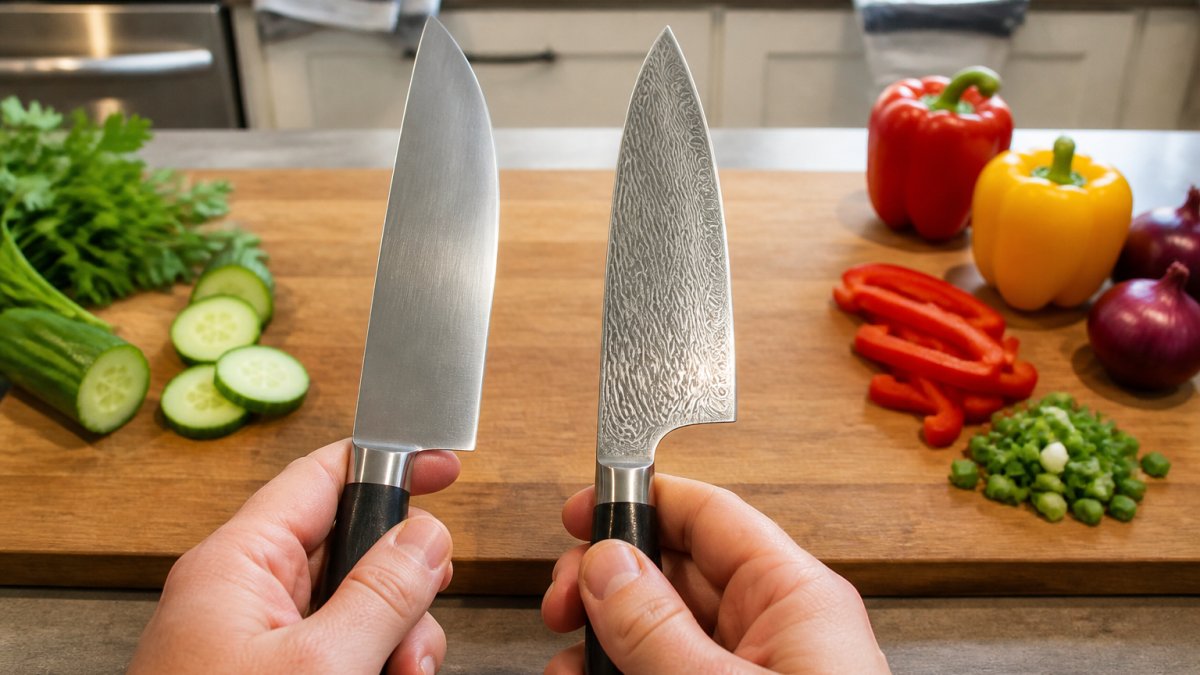
The gap between a budget set and a premium one comes down to three things: steel, construction, and finishing. Cheap knives often use softer stainless steel that dulls quickly and cannot hold a fine edge. Expensive knives use harder steels, tighter manufacturing tolerances, and handles built to survive years of daily washing and chopping.
Steel and Hardness: The Core Difference
Blade hardness is the measure of how well a steel resists scratching and dulling, and it is the single biggest factor separating cheap knives from premium ones. High-carbon steels like VG-10 hold an edge far longer than basic stainless. Our Damascus VG10 Chef Knife uses a 67-layer VG-10 Damascus core rated at 62+ Rockwell hardness, which means it resists dulling through months of regular use. A cheap blade at half that hardness needs sharpening far more often, and each sharpening removes metal you cannot get back.

Full Tang Construction and Handle Materials
A full tang means the blade steel runs the entire length of the handle, giving the knife strength and balance that a partial tang cannot match. Cheap sets often glue a short blade stub into a hollow handle, and that joint is where failures happen. Handle material matters too: Pakkawood resists moisture and swelling in a way that cheap painted wood does not. When you compare cheap and expensive sets, look at the tang and handle first. They tell you more about durability than the label does.
Knife Set vs. Individual Knives: Which Route Fits Your Kitchen
For most home cooks, buying a few individual knives beats a big set. The knife set vs. individual knives debate usually comes down to one question: will you use every piece? Most people reach for a chef's knife or santoku, a paring knife, and a serrated bread knife. The rest of a 12-piece block often sits untouched.
Buying separately lets you put your budget into the two or three knives you actually hold every day. A set makes sense when you are outfitting a first kitchen and want matching tools plus storage in one purchase. Our Kitchen Knife Set Kit bundles five knives, a magnetic rack, and a sharpener.
What to Look for in a Knife Set Before You Spend
Focus on four things before you spend: steel quality, full tang construction, edge geometry, and how the handle feels in your hand. Ignore piece count and packaging. A set with eight great knives beats a set with fifteen mediocre ones every time.
Edge Geometry, Balance, and Comfort
Edge geometry is the shape and angle of the cutting edge, and it determines how cleanly a knife slices. A shallow angle cuts with less effort but needs more care; a steeper angle holds up to tougher work. Our Damascus blades are double-beveled at 12-18 degrees per side, a balance that slices cleanly through vegetables and proteins without feeling fragile.
Balance and comfort decide whether you enjoy using a knife. A well-balanced blade sits where the handle meets the steel, so your wrist does not fight the weight. Hold any knife before you commit. If the handle feels wrong in the first ten seconds, it will feel wrong after ten minutes of prep.
Cost Per Use: The Long-Term Math on Knife Sets
Cost per use is the clearest way to judge whether expensive knife sets are worth it, but most comparisons stop at the sticker price. A fair comparison adds up four costs over several years: what you pay upfront, what you spend keeping the edges sharp, what you spend replacing worn-out pieces, and what you spend on maintenance like honing rods, storage, and protective sheaths. When you line up those four numbers side by side, the picture changes fast.
Take a typical budget block. A $30 set of eight knives used twice a week works out to roughly four cents per use in year one, until the soft steel dulls and the blades start tearing tomatoes instead of slicing them. Most budget sets at that price point need sharpening every few weeks, and each pass on a stone or pull-through sharpener removes metal you cannot get back. Within a year or two, the chef's knife is the only piece still in rotation, and you are shopping for a replacement. The sticker price was low; the cost per usable year was not.
Damascus VG10 Steel Santoku Knife Classic Wave →
Now compare a single well-made knife. Our Damascus VG10 Chef Knife at $79, used daily for five years, works out to pennies per use. The 62+ Rockwell hardness means it holds an edge through months of regular cooking, so sharpening is an occasional maintenance task rather than a monthly chore. Add a $20 honing rod and a $15 magnetic strip, and the total cost of ownership over five years is still lower than replacing a budget block two or three times.
| Cost Factor | Budget Set ($30) | Mid-Range Single Knife ($79) | Premium Set ($150+) |
|---|---|---|---|
| Upfront cost | $30 | $79 | $150+ |
| Sharpening over 5 years | Frequent; $0-$60 in tools or service | Occasional; $20 honing rod | Occasional; $20-$40 |
| Replacement over 5 years | Likely 1-2 replacements; $30-$60 | Rare | Rare |
| Storage and care | Block included; $0 | $15 magnetic strip | Block or strip; $0-$40 |
| Approx. 5-year total | $60-$150 | $114-$134 | $170-$230 |
| Cost per daily use (5 yrs) | Higher than sticker suggests | Lowest | Moderate |
The math favors the mid-range single knife for most daily cooks, but the premium set can close the gap if you actually use most of its pieces. That is the catch: a $150 set only pays off when the knives inside it earn their place. A set with eight great knives used daily beats a $79 single knife used daily; a set with three useful knives and five fillers does not. Our Kitchen Knife Set Kit is built around five knives, which keeps the cost-per-use math honest instead of padding the count.
The Best Affordable Knife Set Options for Real Kitchens
The best affordable knife set is one that puts quality steel and solid construction ahead of piece count. You do not need to spend a fortune to get knives that stay sharp and feel good in your hand.
Our Kitchen Knife Set with Titanium Coated Blades gives you five essential knives, including an 8-inch chef knife, bread knife, santoku, utility knife, and paring knife, for $25. Each blade is food-grade stainless steel with a non-stick titanium coating, and every knife ships with its own protective sheath. For cooks who want a single do-everything blade, our Damascus VG10 Santoku Knife at $79 delivers professional-grade steel and a Pakkawood handle.

How to Care for Kitchen Knives So They Last
Good care is what separates a knife that lasts a decade from one that rusts in a year. Hand wash every blade with mild detergent and dry it immediately. Never leave knives soaking in the sink or run premium steel through a dishwasher, where heat and harsh detergent wear down the edge and handle.
Store knives in a block, on a magnetic strip, or in their sheaths so the edges do not knock against other metal. Hone lightly between uses and sharpen on a stone or with a quality sharpener when the blade starts to drag. Our Damascus VG10 Steel Santoku Knife Classic Wave carries a lifetime guarantee against manufacturing defects, and treating it well is how you get the full value of that promise.

Frequently Asked Questions
Are expensive kitchen knives sharper than affordable ones?
Not necessarily out of the box, but they tend to stay sharp longer. A premium blade like the Damascus VG10 Chef Knife from SiliSlick® uses a high-carbon VG-10 core rated around 62+ Rockwell Hardness, which resists dulling better than softer budget steel. Affordable sets can be sharpened to a fine edge, but that edge rolls or wears faster with daily cooking. The practical difference shows up after weeks of use, not on day one.
Is it better to buy a knife set or individual knives?
It depends on how you cook. A set covers everything at once and often costs less per knife, while individual knives let you spend more on the two or three you reach for daily. The knife set vs. individual knives question usually comes down to use frequency: cooks who prepare meals most days benefit from a coherent set with matching balance and storage, while occasional cooks often do fine with a single chef's knife and a paring knife.
How much should you spend on a good knife set?
There is no single number, but the smart approach is to price it per knife and per year of use. A $25 set that dulls in a year costs more over five years than a $79 knife that holds its edge with occasional honing. Look at what each blade is made of, whether it is full tang, and what the warranty covers before deciding a price is too high or too low.
How long should a quality kitchen knife last?
With proper care, a well-made knife can last decades. SiliSlick® backs its Damascus knives with a lifetime guarantee against manufacturing defects in material and workmanship, plus a 30-day satisfaction return policy. Longevity depends heavily on maintenance: hand washing, drying immediately, storing safely, and sharpening on a stone rather than pulling through a coarse sharpener every week.
What features make a knife set worth the price?
Focus on steel type, hardness, edge geometry, full tang construction, and handle material. A high-carbon core, a double-beveled edge sharpened to 12-18 degrees per side, and a moisture-resistant Pakkawood handle all signal a set built to perform. Storage and a sharpener add practical value. If a set checks these boxes and fits how often you cook, the price is easier to justify.
The challenge is not finding an expensive knife set. It is spending your money where it actually improves your cooking. At SiliSlick®, we build full-tang knives with Damascus VG-10 steel, Pakkawood handles, and finishes designed to hold up to daily use, all without the markup of a bloated block. Shop our kitchen knife collection and put your budget into blades that earn their place on your counter.