
Quick Summary
The best JW SteelCrafts alternative for damascus knives depends on what you cook and how you want the knife to perform. Check the core steel, layer count, hardness and origin before buying, since the surface pattern alone says little about quality. SiliSlick's VG10 range offers 67-layer damascus construction with defined specifications.
- Core steel and layer count matter more than the surface pattern on damascus blades.
- Our VG10 blades use 67 layers of VG-10 damascus stainless steel around a high-carbon core.
- The VG10 core is rated around 62+ on the Rockwell scale for edge retention.
- Production blades come with defined specs and a stated warranty, unlike most custom knives.
- Every SiliSlick knife includes a gift box and a lifetime guarantee against manufacturing defects.
Table of Contents
- What to Look for in a Damascus Kitchen Knife
- Comparing Damascus Steel and San Mai Blades
- Which Damascus Knives Are Made in USA?
- SiliSlick Damascus Knives as a JW SteelCrafts Alternative
- Choosing a Handmade or Custom Damascus Knife vs. a Production Blade
- Pick Your Damascus Knife and Start Cooking
- Frequently Asked Questions
Is There a Better JW SteelCrafts Alternative for Damascus Knives?
Last Updated: November 4, 2026
What to Look for in a Damascus Kitchen Knife
Shoppers searching for a jwsteelcrafts alternative for damascus knives usually want the same thing: a sharp, good-looking blade that holds up to daily cooking. At SiliSlick®, we build our Damascus knives around that balance, and this guide walks through what matters before you buy.
Damascus knives are made by folding and forging layers of steel into a patterned blade. The pattern is what catches the eye, but the steel underneath decides how the knife performs. Damascus is a construction method, not a single steel type, so two knives that look alike can cut very differently.
Damascus Steel Construction and Layered Patterns
Layer count and core steel matter more than the wave or ripple on the surface. Our VG10 knives use 67 layers of VG-10 Damascus stainless steel around a high-carbon core, which gives the blade a striking pattern.
Pattern alone tells you little about quality. Ask what the core steel is and how many layers the blade has. If a seller cannot answer, keep looking.
Blade Materials, Hardness, and Edge Retention
Hardness and edge retention determine how long a knife stays sharp between sharpenings. Our VG10 blades have a core rated around 62+ on the Rockwell scale.
Harder steel holds an edge longer but can chip if you pry or twist it. For most home cooks, a firm blade with a moderately thin edge offers the best mix of sharpness and durability.
Comparing Damascus Steel and San Mai Blades
Damascus and San Mai are two common ways to build a layered blade, and they are often confused. A Damascus blade is made from many layers of steel forged together, with the pattern running through the whole blade. A San Mai blade has a hard core steel sandwiched between softer outer layers, and the pattern usually appears only on the sides.
For a kitchen knife, the practical difference is the cutting core. Damascus gives you a patterned blade built from several layers, while San Mai focuses on a single hard steel core protected by softer cladding. If you want a visually striking blade with a layered core, our Damascus VG10 range is the more direct fit.
Which Damascus Knives Are Made in USA?
Origin is one of the least transparent parts of the Damascus knife market. Many patterned blades are forged and assembled overseas, and listings often omit where the steel is rolled, where the blade is ground, and where the handle is attached. For buyers, that matters because origin affects warranty support, replacement parts, and how easily you can verify the maker's claims.
A practical approach is to treat origin as a checklist item, not a marketing badge. Look for a specific statement of where the blade is forged and where the knife is assembled. If a seller only says "imported steel" or "global materials," ask for the country of origin in writing before you order. Reputable makers will answer; vague ones usually will not.
For most home cooks, a production knife with clearly stated specifications is a practical choice. Each SiliSlick® listing states the steel, layer count, and handle material so you can compare like for like. When you evaluate any alternative, insist on the same transparency: core steel, layer count, hardness, and origin. If those details are missing, the pattern on the blade is doing more selling than the steel underneath.
SiliSlick Damascus Knives as a JW SteelCrafts Alternative
If you are looking for a jwsteelcrafts alternative for damascus knives, our three VG10 options cover the most common kitchen needs. Each one uses 67-layer VG-10 Damascus construction and a Pakkawood handle, so the choice mostly comes down to shape and size.
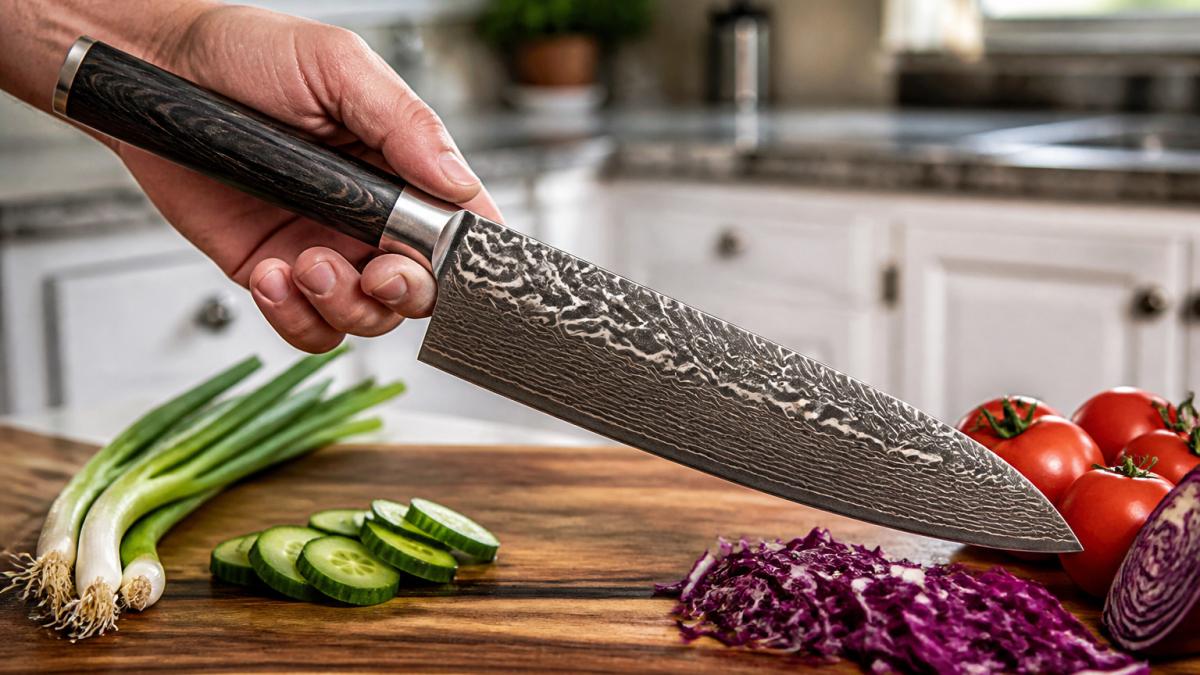
!Close-up of a hand holding a Damascus VG10 santoku knife with a wave-pattern blade over a wooden cutting board with fresh vegetables in a bright home kitchen
Damascus VG10 Steel Santoku Knife Classic Wave →
Damascus VG10 Santoku Knife Classic Wave
The Classic Wave santoku is a versatile option for everyday prep. Its blade is about 4.5 inches long within a 7-inch total length, and the double bevel is sharpened to 12-18 degrees per side. At $79.00, it is a practical choice for home cooks who want one multipurpose knife for chopping, slicing, and dicing.
Best for: Home cooks who want one all-purpose knife. Skip if: You need a long blade for large cuts of meat.
Damascus VG10 Chef Knife, Hammered Blade
The hammered chef knife has an 8-inch blade and weighs about 250 grams, so it suits larger cutting jobs. The hammered finish gives the blade a distinctive surface. It is priced at $79.00.
Best for: Cooks who prefer a longer blade for bigger tasks. Skip if: You want a lighter knife for delicate, small-scale cuts.
Damascus VG10 Santoku Knife, 7.25-Inch Blade
The 7.25-inch santoku is a classic Japanese-style knife with a Pakkawood handle and a double bevel. It is priced at $79.00 and is built for precise slicing and dicing. Each knife in this range includes a gift box and a lifetime guarantee against manufacturing defects.
Best for: Cooks who want a balanced, precise santoku. Skip if: You need a dedicated boning or bread knife.
The three VG10 options below share the same core construction, so the main differences are shape and size.
| Knife | Best For |
|---|---|
| Damascus VG10 Santoku Classic Wave | One all-purpose knife |
| Damascus VG10 Chef Knife, Hammered Blade | Larger cutting jobs |
| Damascus VG10 Santoku, 7.25-Inch Blade | Balanced, precise slicing |
Choosing a Handmade or Custom Damascus Knife vs. a Production Blade
Handmade and custom Damascus knives are made one at a time, which usually means higher prices, longer waits, and variation from knife to knife. They can suit collectors or cooks who want a unique blade and are willing to accept the maintenance and care that come with a high-carbon core. Production blades, by contrast, come with defined specs and a stated warranty.
For most home kitchens, the decision comes down to three factors: how often you cook, how much maintenance you will tolerate, and whether you need a warranty you can actually use. A production knife gives you steady quality at a lower cost, and you know the blade length, steel, and handle material before you order. A custom knife gives you character and exclusivity, but you may wait months and have less recourse if something goes wrong. For a concrete production option to compare against, see the Damascus Chef Wave knife.
Our SiliSlick® knives come with defined specifications, include a gift box, and carry a lifetime guarantee against manufacturing defects, so you can compare them on steel, hardness, handle material, and support after the sale.
Pick Your Damascus Knife and Start Cooking
Choosing a Damascus knife comes down to what you cook and how you want the knife to look. If you want one all-purpose blade, start with the Classic Wave santoku. If you need more length, the hammered chef knife is the better fit.
Explore the full range at shop SiliSlick Damascus knives, or read our guide on caring for Damascus steel to keep your blade sharp for years.
Frequently Asked Questions
Which brands make the best Damascus steel knives?
Several makers produce Damascus knives at different price points, and the best choice depends on how you cook. For a kitchen knife at a moderate price, the SiliSlick Damascus VG10 line is a practical option: each blade uses 67 layers of VG-10 stainless steel with a core rated around 62+ Rockwell Hardness, and the models sell for $79.00. Compare steel construction, handle material, and warranty terms before deciding, and match the knife's blade length to the tasks you do most often.
Is there such a thing as fake Damascus steel?
Yes. Many knives sold as Damascus have an etched or laser-printed pattern on a single piece of steel rather than a true layered blade. Etched patterns look similar at a glance but do not have the layered construction that defines pattern-welded steel. Check the product listing for the number of layers and the steel type. SiliSlick lists its Damascus blades as 67 layers of VG-10 Damascus stainless steel, so you can verify the construction before you buy.
Are Damascus knives good for everyday cooking?
They can be, provided the knife fits your routine. A santoku or chef knife with a 7 to 8 inch blade handles slicing vegetables, chopping herbs, and dicing meat for most home cooks. The Damascus VG10 Chef Knife with a hammered blade and the Damascus VG10 Santoku Knife are both sold as multipurpose kitchen knives at $79.00.
