

Last Updated: November 2, 2026
Quick Summary
To choose a green handle kitchen knife set, pick five core knives: a chef's knife, bread knife, Santoku, utility knife, and paring knife. Choose molded-in or dyed-through color over painted handles, and check for full tang construction and food grade stainless steel blades.
- A complete set covers five jobs: chef's knife, bread knife, Santoku, utility knife, and paring knife.
- Molded-in or dyed-through color outlasts painted or coated handles, which chip at the edges.
- Hold the chef's knife and rock it to check the pivot point sits at your index finger.
- Hand wash colored handles, dry immediately, and skip the dishwasher to protect the dye.
- The standalone set costs $25.00; the rack kits cost $28.00 and add a sharpener and magnetic rack.
Table of Contents
- What Knives Should a Kitchen Knife Set Include
- Green Handle Kitchen Knife Set Materials and Color Durability
- Full Tang Kitchen Knife Set Construction and Balance
- Chef Knife vs Santoku: Which Belongs in Your Set
- Stainless Steel Kitchen Knife Care for Colored Handles
- Green Handle Kitchen Knife Set Comparison and Pricing
- Shop SiliSlick Green Handle Knife Sets
- Frequently Asked Questions
What Knives Should a Kitchen Knife Set Include
A complete kitchen knife set should cover five core jobs: a chef's knife for chopping, a bread knife for slicing, a Santoku for precision dicing, a utility knife for mid-size tasks, and a paring knife for detail work. That five-piece lineup handles nearly everything a home cook does, which is why the Kitchen Knife Set - Green Handle is built around exactly those blades.

Most sets fail because they pad the count with pieces you never reach for. A second paring knife, a carving fork, six steak knives: these look generous in the box and collect dust in the drawer. Our advice is to buy fewer, better knives and add pieces as your cooking actually demands them.
If you want matching steak knives to round out the table, a dedicated steak knife set with green handles pairs with the core block without duplicating anything.
Here's the working list we'd start with:
- Chef's knife - the workhorse for chopping, mincing, and slicing
- Bread knife - serrated, for crusty loaves and tomatoes
- Santoku - thin slices, clean dices, delicate work
- Utility knife - sandwiches, fruit, smaller cuts
- Paring knife - peeling, trimming, in-hand work
Green Handle Kitchen Knife Set Materials and Color Durability
Green handles are usually molded from one of three materials, and the material decides how the color ages:
- Polypropylene (PP): the most common handle plastic. It is lightweight, water-resistant, and inexpensive. Color is typically compounded into the resin, so it runs through the handle rather than sitting on top. It can feel slick when wet unless the handle has a textured pattern.
- Thermoplastic rubber (TPR) or rubberized composite: a softer overmold, often paired with a rigid core. It grips well with wet hands and absorbs some vibration, but the rubber surface can attract stains from turmeric, beets, and tomato sauce if not washed promptly.
- Pakkawood or stabilized wood: layered wood impregnated with resin. It looks premium and holds dye well, but it is the least forgiving if left wet. Green pakkawood handles are usually dyed through the layers, so scratches show less than they would on a coated surface.
How the color is applied matters as much as the material. Dyed-through or molded-in color is the most durable option because the pigment is part of the handle itself; scuffs and shallow scratches do not expose a different color underneath. Painted or coated handles sit on top of the substrate and tend to chip at the edges where your fingers press hardest, especially after repeated washing. When you shop, look for language like "molded-in color" or "through-color" rather than "painted" or "coated."
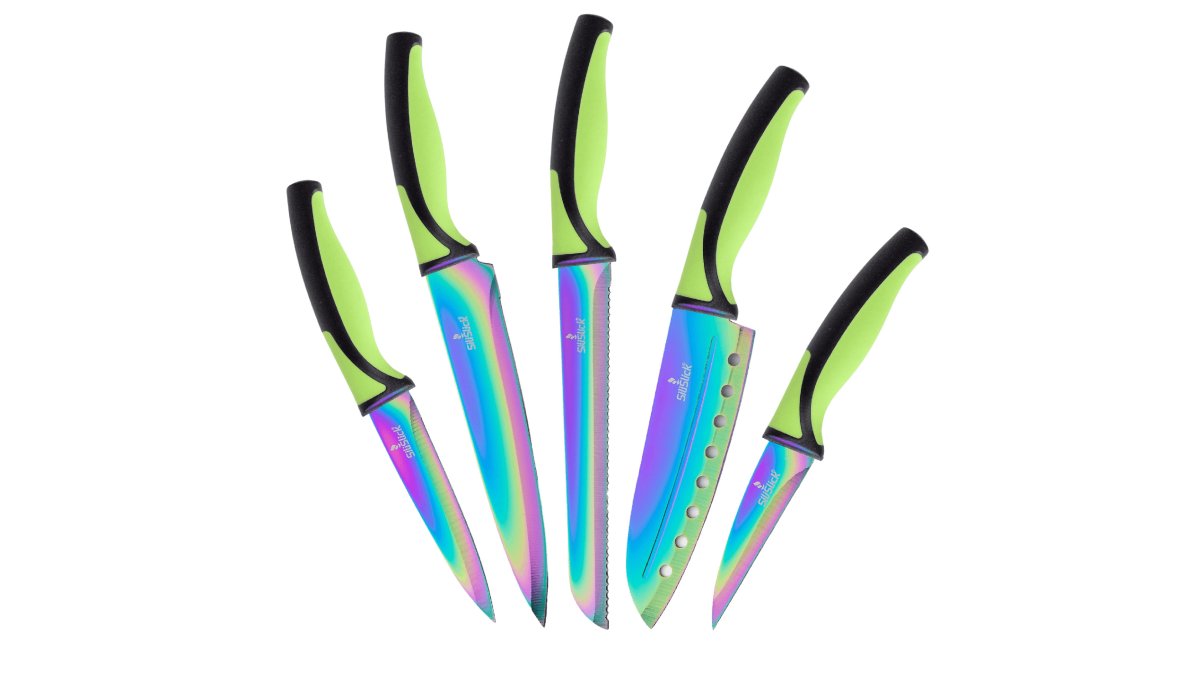
The blades matter just as much. SiliSlick® knives use food grade stainless steel with a non-stick titanium coating, which gives the iridescent finish and corrosion resistance. A common mistake is judging a colored set by the handle alone and ignoring the steel underneath.
Hand washing is the gentler choice for colored handles and blade coatings.
Full Tang Kitchen Knife Set Construction and Balance
A full tang knife is one where the steel runs through the length of the handle. SiliSlick® offers full tang knife kits, so the construction is part of what you are buying.
Balance changes how you cut. A knife weighted toward the handle suits delicate work; one weighted toward the blade powers through dense vegetables. Neither is wrong, but you want the knife to feel like an extension of your hand rather than something you're gripping to stop it twisting. Achieving this ergonomic harmony ensures that your tools remain reliable for years, a principle explored further in our sustainable kitchenware guide.
When you pick up a set, hold the chef's knife and rock it forward and back. If the pivot point sits right where your index finger meets the blade, the knife will do most of the work for you.
Chef Knife vs Santoku: Which Belongs in Your Set
The chef knife and the Santoku do overlapping jobs, and the honest answer is that most cooks benefit from having both. The chef's knife has a curved belly that lets you rock-chop herbs and mince garlic in a continuous motion. The Santoku has a flatter edge and a thinner profile, better for clean downward slices through vegetables and fish.
A chef knife is the better single-knife choice if you can only own one. It handles more tasks, and its curve makes it forgiving for beginners learning to chop.
Kitchen Knife Set - Green Handle →
SiliSlick® includes both in the Kitchen Knife Set - Green Handle, so you're not choosing between them.
Stainless Steel Kitchen Knife Care for Colored Handles
Stainless steel kitchen knife care comes down to three habits: wash by hand, dry immediately, and store where the edge isn't touching anything hard. For deeper guidance on stainless steel knife sets and their care, see our full guide. Stainless steel resists rust but isn't rust-proof, and a wet blade left in a sink is where corrosion starts.
For colored handles specifically, the care routine needs a few extra steps:
- Skip the dishwasher. Heat and harsh detergent fade dye and can loosen the handle material over time. Even handles labeled dishwasher safe tend to dull faster in practice. A quick hand wash with mild soap and a towel dry is enough.
- Address stains early. Turmeric, beets, tomato sauce, and berry juice can leave a tint on rubberized and porous handles. Wash promptly after use; for stubborn marks, a paste of baking soda and water applied with a soft cloth usually lifts the stain without abrading the surface.
- Watch for loose rivets or handles. If the handle feels loose, stop using the knife and check the rivets. A loose handle is a safety issue, not just a cosmetic one. Most manufacturers specify care in the product insert; follow those instructions over general advice.
- Store dry and protected. A magnetic rack, a block, or the included safety sheaths keep the edge from contacting other metal. Moisture trapped in a sheath or block can affect both the blade and the handle over time, so let the knife air-dry fully before storing.
Honing is different from sharpening. A honing rod realigns the edge before each use; sharpening removes metal to create a new edge.
Green Handle Kitchen Knife Set Comparison and Pricing
SiliSlick® offers green handle knife sets with and without storage, and the right pick depends on whether you want a rack included.
| Set | What's Included | Price | Best For |
|---|---|---|---|
| Kitchen Knife Set - Green Handle | 5 knives with safety sheaths, gift-ready box | $25.00 | First apartment, gifting |
| Kitchen Knife Set Kit - Green Handle & Black Rack | 5 knives, sheaths, sharpener, black magnetic rack | $28.00 | Countertop storage |
| Kitchen Knife Set Kit - Green Handle & Red Rack | 5 knives, sheaths, sharpener, red magnetic rack | $28.00 | A bolder kitchen accent |
The difference is small: for a few dollars more than the standalone set, the kits add a magnetic rack and a sharpener. If you're weighing colored handles more broadly, our blue handle kitchen knife set comparison runs the same exercise for blue options.
For the rack bundle, you can compare the Kitchen Knife Set Kit - Green Handle & Black Rack against the standalone set before deciding.

Shop SiliSlick Green Handle Knife Sets
If the five-knife lineup above matches how you actually cook, the decision is mostly about storage. SiliSlick® is a family-owned business, and we built these sets for home cooks who want professional-grade tools at an accessible price.
Every knife in the lineup is coated in non-stick titanium and paired with an ergonomic handle designed for a secure grip. Each knife comes with a safety sheath, and the set is stored in a recyclable, gift-ready box.
Ready to upgrade your prep? Shop the green handle knife set and put a sharp, professional-style knife in your hand this week.
Frequently Asked Questions
Are green handle kitchen knives comfortable to use?
Comfort depends on handle shape and material, not color. Look for an ergonomic handle that fills your palm without forcing your wrist to bend. A green handle kitchen knife set with contoured grips and a full tang gives you a secure feel during long chopping sessions. SiliSlick's green handle knives use ergonomic handles designed for a secure, comfortable grip, and the non-stick titanium coating is designed for easy slicing.
Can kitchen knives with coated blades go in the dishwasher?
Hand washing is the safer choice for any coated or colored knife. Hand washing is the gentler routine for colored and coated knives. Wash each blade with mild soap, rinse, and dry immediately with a towel. Store knives in their sheaths or on a magnetic rack rather than loose in a drawer. For a green handle kitchen knife set, this routine protects both the color finish and the cutting edge.
What is the difference between a chef's knife and a santoku knife?
Many cooks keep both knife types. SiliSlick's green handle sets include an 8-inch chef knife and a 7-inch santoku, so you can match the blade to the task.
How many knives does a home cook actually need?
Most home cooks get by with four or five: a chef's knife, a paring knife, a serrated bread knife, and a utility knife, plus a santoku if you do a lot of vegetable prep. A five-piece green handle kitchen knife set covers those tasks without redundant pieces. Skip sets that pile in duplicates you will never use.
The gap between a set that frustrates you and one you reach for daily usually comes down to construction and grip, not price. SiliSlick® builds full tang knives with titanium-coated stainless steel blades, ergonomic handles, and protective sheaths so your set stays sharp and safe between uses. Get started with SiliSlick® and give your kitchen a set that looks as good as it cuts.
