

Table of Contents
- What "Rainbow Titanium" Actually Means on a Knife
- Titanium-Coated Knife Edge Retention: What the Coating Does and Doesn't Do
- How to Sharpen Coated Kitchen Knives Without Ruining the Finish
- Knife Honing vs Sharpening: Which One Does Your Blade Need?
- Rainbow Titanium Knife Care: Simple Habits That Preserve Sharpness and Shine
- Conclusion
- Frequently Asked Questions
Last Updated: October 9, 2026
What "Rainbow Titanium" Actually Means on a Knife
Rainbow titanium knives are stainless steel blades with a thin titanium-based coating on top, not blades cut from solid titanium.

At SiliSlick®, we build our rainbow titanium knives this way on purpose. The steel core does the cutting.
Here's why that matters: solid titanium is soft. The ASM International overview of titanium properties explains why titanium on its own rarely holds a fine edge.
So when someone asks whether rainbow titanium knives stay sharp, the honest answer is that the steel edge stays sharp. The coating is a separate story.
Coating vs. Solid Titanium: A Critical Difference
A coating is a surface treatment measured in microns. Solid titanium is the whole blade.
- Coated blade: steel core, titanium-based finish on top
- Solid titanium blade: titanium all the way through, lighter but softer
- What you feel in use: coated blades cut like stainless steel because they are stainless steel underneath
This is why a rainbow titanium knife can slice a steak cleanly and still look bright after months of dinners. The two jobs belong to two different layers.
Titanium-Coated Knife Edge Retention: What the Coating Does and Doesn't Do
Titanium-coated knife edge retention depends on the steel under the coating, not the coating itself. The finish protects against rust and food sticking. It does not make the edge harder or slower to dull.
That's the key idea, and it's where a lot of product pages get vague. A coating can wear away at the edge over time. It cannot sharpen your knife for you.
What the coating does:
- Adds a non-stick surface so food releases cleanly
- Improves corrosion resistance on the blade face
- Creates the iridescent rainbow look
What it does not do:
- Increase blade hardness
- Slow sharpness loss at the cutting edge
- Replace honing or sharpening
Why the Coating Wears at the Edge First
A titanium-based finish is measured in microns, and it sits on top of the steel. The cutting edge is the thinnest, most exposed part of the blade. Every stroke through food and across a board abrades that thin film.
This is normal and not a defect. It also explains a common observation: a rainbow knife can look bright across the blade face while the edge shows a faint line of steel.
Realistic Edge Retention by Task
How long a coated stainless blade stays sharp depends on what you cut and what you cut on. Here is a practical breakdown for home kitchens:
| Task | Typical Edge Life Between Honing | Notes |
|---|---|---|
| Slicing cooked steak, chicken, vegetables | Several weeks of regular dinners | Soft foods, low abrasion |
| Breaking down raw poultry or trimming fat | 1-2 weeks | Connective tissue and bone contact dull edges faster |
| Cutting on wood or soft plastic boards | Baseline | Gentle on edges |
| Cutting on glass, stone, or ceramic | Days, not weeks | Hard boards micro-chip any edge |
| Frozen foods or dense root vegetables | 1-2 sessions | High resistance accelerates dulling |
A coated steak knife used a few times a week on a wood board commonly goes one to three months between full sharpenings if you hone in between. Heavy daily prep work shortens that window. These are practical patterns, not laboratory guarantees, your technique and board choice matter as much as the blade.

What Actually Determines Edge Retention
Four factors drive how long any knife stays sharp, and the rainbow finish is not one of them:
- Steel substrate: the alloy and carbon content of the core steel set the ceiling on hardness and wear resistance.
- Heat treatment: how the steel was hardened and tempered determines whether it holds a fine edge or rolls.
- Edge geometry: a thinner bevel slices better but dulls faster; a thicker bevel is more durable but less keen.
- Use and maintenance: board material, cutting technique, honing frequency, and storage all extend or shorten edge life.
Judge a rainbow titanium knife by its steel core and edge geometry. The coating is a finish, not a sharpening system.
How to Sharpen Coated Kitchen Knives Without Ruining the Finish
Learning how to sharpen coated kitchen knives comes down to one rule: sharpen the edge, protect the face. Work only the bevel, keep the angle steady, and the rainbow finish stays intact.
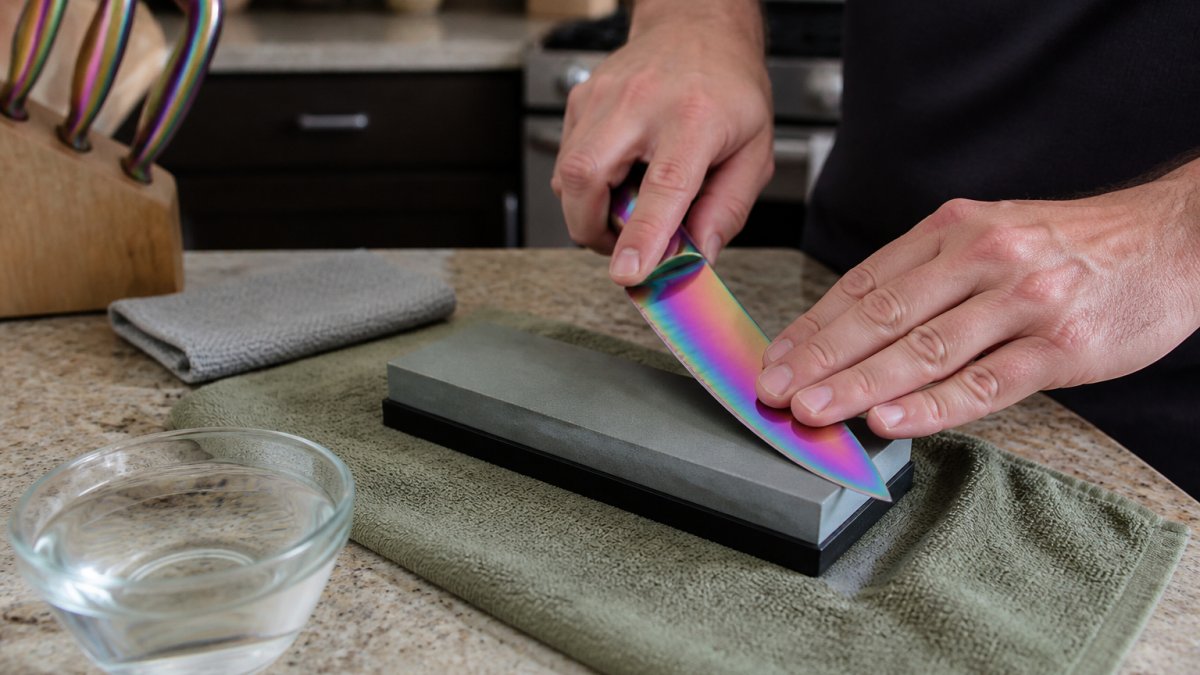
You don't need much gear. A two-sided whetstone, water, and a steady hand cover most home kitchens.
- Low grit side: repairs a dull or nicked edge
- High grit side: refines and polishes the edge
- Leather strop or honing rod: realigns the edge between full sharpenings
Skip electric pull-through sharpeners with carbide blades. They strip metal fast and can scuff the coating near the edge.
Step-by-Step: Sharpening a Rainbow Titanium Blade
Follow these steps in order. Total time runs about 15 to 20 minutes for a full set.
- Soak the stone. Submerge a water stone for 10 to 15 minutes before use.
- Find the angle. Match the factory bevel, usually around 15 to 20 degrees per side on kitchen knives.
- Lock your wrist. Hold the angle steady and draw the edge across the stone in smooth strokes.
- Work one side. Make 5 to 10 passes, then check for a burr on the opposite side.
- Flip and repeat. Match the same number of passes on the other side.
- Move to the fine grit. Lighten your pressure and refine the edge.
- Strop to finish. A few passes on leather removes the last burr.
- Wash and dry. Hand wash with mild soap, then dry right away.
What to expect: the edge should catch on a tomato skin or slice paper cleanly. If it doesn't, add a few more light passes.
Knife Honing vs Sharpening: Which One Does Your Blade Need?
Knife honing vs sharpening is the difference between realigning an edge and removing metal to create a new one. Honing is maintenance. Sharpening is repair.
Steak Knife Set 4 Rainbow Titanium Coated Blades & Black Handles →
Hone when the knife still cuts but feels slightly tired. Sharpen when the edge is genuinely dull, nicked, or won't bite into food at all.
| Task | What It Does | How Often | Tool |
|---|---|---|---|
| Honing | Realigns the edge | Weekly, or before heavy use | Honing rod or strop |
| Sharpening | Removes metal to rebuild the edge | Every few months | Whetstone |
| Wiping and drying | Prevents corrosion and stains | After every wash | Soft cloth |
Most home cooks sharpen far less often than they think.
A Simple Test to Decide
Before you reach for a stone, run one quick check:
- Paper test. Hold a sheet of printer paper upright and slice downward. A sharp edge glides through; a dull edge tears or snags.
- Tomato test. If the knife slices paper cleanly but slides off a tomato skin, the edge is misaligned, not worn. Hone it.
- Fingernail test. Lightly draw the edge across a fingernail at a shallow angle. If it bites and catches, the edge is still there. If it skates, it needs sharpening.
If the knife passes the paper test but fails the tomato test, hone. If it fails both, sharpen.
Honing a Coated Blade Without Damaging the Finish
This is the part most guides skip. A honing rod contacts the edge bevel, not the flat face of the blade, so a few light strokes along the bevel will not touch the rainbow finish.
- Match the bevel angle. Keep the rod at the same angle as the factory edge, usually 15 to 20 degrees per side on kitchen knives.
- Use light pressure. You are realigning metal, not grinding it. Heavy pressure removes steel and can scuff the coating near the edge.
- Stay on the bevel. If the rod rides up onto the flat face, it will scratch the finish.
- Consider a strop instead. A leather strop with a light compound realigns an edge with even less risk to a decorative finish than a grooved rod.
A ceramic honing rod is gentler than a diamond or carbide rod and is a good match for coated blades. Avoid pull-through sharpeners with carbide blades entirely, they strip metal fast and can chew the coating near the edge.
How Often to Hone vs Sharpen
A practical rhythm for a home kitchen:
- Hone: once a week with regular use, or right before a big meal.
- Sharpen: every two to three months for a knife used several times a week, or sooner if the edge is nicked or visibly rounded.
- Strop: any time between honing sessions if the edge feels slightly tired.
If you cut on wood or soft plastic and hand wash and dry your knives, you will sharpen far less often than the calendar suggests. If you cut on glass or stone, expect to sharpen much more frequently, hard boards are the single biggest cause of premature dulling.
Rainbow Titanium Knife Care: Simple Habits That Preserve Sharpness and Shine
Rainbow titanium knife care is mostly about avoiding the two things that ruin both edge and finish: heat and moisture left sitting.
Hand wash these knives with mild soap and warm water. Dry them right away. Dishwashers combine high heat, harsh detergent, and jostling that chips coatings and dulls edges.
A few habits go a long way:
- Cut on wood or soft plastic boards, never glass or stone
- Store knives in their sheaths or on a magnetic strip
- Avoid soaking blades in the sink
- Skip the dishwasher entirely
Our Steak Knife Set 6 Rainbow Titanium Coated Blades & Red Handles ships with rust-proof safety sheaths for exactly this reason.
For smaller households, the Steak Knife Set 4 Rainbow Titanium Coated Blades & Black Handles covers four place settings at $16.00. The blue-handled four-piece set offers the same build in a cooler tone.

One more thing worth knowing: a rainbow finish is decorative, not a hardness rating. The U.S. Department of Agriculture food safety guidance reminds home cooks that clean, dry knives are also safer knives, since bacteria linger on damp blades and handles.
Conclusion
The real question isn't whether the rainbow fades, it's whether you're caring for the steel underneath. Coated blades stay sharp when you hone often, sharpen rarely, and keep them dry.
At SiliSlick®, our rainbow titanium coated stainless steel knives are built for exactly that routine: full-tang construction, ergonomic handles, and non-stick blades that clean up fast.
Shop our rainbow titanium knife sets and give your table a set that looks as sharp as it cuts.
Frequently Asked Questions
Do rainbow titanium knives stay sharp longer than stainless steel knives?
The titanium coating does not extend edge retention beyond what the underlying stainless steel blade can deliver. The coating adds a non-stick surface and colorful finish, but the cutting edge itself is exposed stainless steel. With regular honing and occasional sharpening, a rainbow titanium knife stays sharp for the same duration as a comparable uncoated stainless steel knife. The main advantage is easier food release and corrosion resistance, not longer edge life.
Can you sharpen a rainbow titanium-coated knife without damaging the finish?
Yes, but you need to be careful. The titanium coating sits on the blade face, not on the cutting edge itself. When you sharpen, you are grinding the exposed steel edge, so the finish stays intact as long as you do not drag the abrasive across the coated surface. Use a fine-grit stone and keep the angle consistent. Hand washing and drying immediately after use also prevents the finish from clouding.
How often should you sharpen a rainbow titanium knife?
For home cooks using a rainbow titanium steak knife set a few times a week, sharpening every two to three months is typical. Honing with a rod before each use keeps the edge aligned and delays the need for full sharpening. If you notice the blade crushing tomato skins or tearing meat instead of slicing cleanly, it is time to sharpen. Always hand wash and dry immediately to protect the coating between sharpenings.
What is the difference between titanium-coated and solid titanium knives?
A titanium-coated knife has a stainless steel core with a thin titanium-based layer bonded to the surface for color and non-stick properties. A solid titanium knife is made entirely of titanium, which is lighter but softer than steel and loses its edge quickly. Solid titanium knives are rare in kitchens because they cannot hold a sharp edge well. Rainbow titanium knives, like the SiliSlick steak knife sets, use coated stainless steel to combine edge durability with a striking finish.