

Quick Summary
Kitchen knife sets made in USA are sets where the blades are forged or substantially manufactured domestically, not just assembled from imported parts. Check the product page for specific origin wording that separates forging, handle assembly and steel sourcing, since a generic badge alone does not confirm where each step happens.
- A Made in USA label should reflect substantial domestic manufacturing, per FTC guidance.
- Check where the blade is forged, where the handle is assembled, and where the steel is sourced.
- A seller who names each manufacturing step and its location is usually more trustworthy.
- Most home kitchens need three core knives: a chef's knife, a paring knife and a bread knife.
Table of Contents
- What Made in the USA Actually Means for Kitchen Knives
- How to Verify Where Kitchen Knives Are Made
- American-Made Kitchen Knife Brands Worth Knowing
- Best American-Made Kitchen Knife Set Options Compared
- Best Kitchen Knives Made in the USA for Your Cooking Style
- Which Knives a Useful Set Actually Needs
- Choosing Your Kitchen Knife Set and Next Steps
- Frequently Asked Questions
What Made in the USA Actually Means for Kitchen Knives
Last Updated: November 7, 2026
Shoppers searching for kitchen knife sets made in USA often find that the phrase means different things to different sellers. Some brands forge every blade at home. Others assemble imported parts in a domestic workshop. Understanding that difference is the first step to buying with confidence. At SiliSlick®, we believe a clear definition matters more than a catchy label, so this guide starts there.
A "Made in USA" label generally signals that the product was substantially manufactured in the United States (the FTC). The Federal Trade Commission's guidance on country-of-origin claims asks sellers to back up the label with a meaningful amount of domestic processing, and to avoid implying the whole product is domestic when key components are imported. FTC Made in USA Labeling Rules
For kitchen knives, that usually means several questions matter at once:
- Where is the blade made? Forging, grinding and heat treatment are the steps that shape a knife's cutting performance.
- Where is the handle assembled? Handle material and fit affect comfort and durability.
- Where is the steel sourced? A domestic brand can still use imported steel, so the origin of the raw material is worth checking.
Keep these questions in mind as you read the rest of this guide. A set that is assembled in the USA from imported blades is a different product from one that is forged and finished domestically.
How to Verify Where Kitchen Knives Are Made
Verifying origin takes a few minutes of checking, and it protects you from misleading labels. The goal is to move from a badge on the box to a specific, checkable claim about where the blade was forged, where the handle was assembled, and where the steel came from. A useful test is to ask whether the seller can describe the manufacturing steps in order, forging, grinding, heat treatment, handle fitting, finishing, and name the location where each step happens.
Start with the product page and look for language that separates the steps. Phrases such as "forged in the USA," "assembled in the USA from imported components," or "domestically finished with US-sourced steel" tell you more than a generic badge does. Official country-of-origin guidance ask sellers to back up "Made in USA" claims with a meaningful amount of domestic processing and to avoid implying the whole product is domestic when key components are imported. FTC Made in USA Labeling Rules That standard is why the wording matters: a knife can be assembled domestically and still contain imported steel, and a seller should say so plainly.
Next, look for a stated manufacturing location, a factory or workshop description, and clear material sourcing details. Vague claims with no supporting specifics deserve more scrutiny. A common pattern is that strong sellers name the steel type (for example, VG10 or a specified stainless grade), describe the handle material (such as Pakkawood or a synthetic composite), and state where the blade is forged versus where the handle is attached. If a page lists only a country flag and no process details, treat the claim as unverified until you get a direct answer.
Finally, check the packaging and included paperwork, and contact the seller directly if the answer is unclear. Ask a specific question, "Where is the blade forged, and where is the handle assembled?", and note whether the reply is direct or evasive. A seller who can answer in detail is usually the one whose label will hold up.
Here is a quick verification summary:
| Check | What to Look For | Red Flag |
|---|---|---|
| Product page | Specific origin wording that separates forging, assembly, and steel sourcing | Only a vague "American spirit" badge |
| Materials | Named steel grade and handle material with sourcing notes | No material details listed |
| Manufacturing | Where forging, grinding, heat treatment, and handle fitting happen | No location given for any step |
| Paperwork | Packaging or insert that repeats the origin claim | Claim appears only in marketing copy |
| Seller response | Direct, detailed answer to a step-by-step question | Evasive reply or a copy-paste slogan |
Keep these checks in mind as you compare sets. A set that is assembled in the USA from imported blades is a different product from one that is forged and finished domestically, and the verification steps above are how you tell them apart before you buy. When you are ready to compare configurations, you can review the full SiliSlick® knife set collection and check each product page against the table above.
American-Made Kitchen Knife Brands Worth Knowing
Several domestic brands focus on craftsmanship, and a few are known for American-made cutlery. Their strengths tend to show up in blade finishing, handle construction and the consistency of each piece in a set. Compare brands on their own documentation rather than on reputation alone.
SiliSlick® sells full-tang knife sets built for both style and performance, featuring rainbow titanium-coated stainless steel blades and Damascus etched designs. Our family-owned approach centers on durable, innovative tools that make everyday cooking easier to enjoy.
Best American-Made Kitchen Knife Set Options Compared
Our top pick for most home cooks is the SiliSlick® Kitchen Knife Set Kit, which pairs five essential knives with a magnetic rack and sharpener. The full set is priced at $29.00, which makes it a practical starting point for first-time buyers and gift shoppers alike. Explore the complete range of knife sets to compare configurations.
For shoppers who want a complete kit with storage and maintenance tools included, the Kitchen Knife Set Kit with its black magnetic rack and sharpener is an easy choice at $29.00.

Thinking about whether a premium set is worth the cost? Are expensive knife sets worth it? A value comparison walks through steel, edge retention and cost per use.
| Set | Price | Pieces | Best For |
|---|---|---|---|
| Kitchen Knife Set Kit (Black Rack) | $29.00 | 5 knives plus rack and sharpener | Everyday home cooks |
| Kitchen Knife Set Kit (Red Rack) | $29.00 | 5 knives plus rack and portable sharpener | Cooks who want color |
| Kitchen Knife Set & Steak Knife Bundle | $45.90 | Knife set plus steak knives | Entertaining |
| Damascus VG10 Chef Knife | $79.00 | Single chef knife | A premium centerpiece blade |
Price
Best Kitchen Knives Made in the USA for Your Cooking Style
Your cooking style should guide your choice more than any single feature. Weekend cooks who mostly slice vegetables and proteins benefit from a balanced set with a chef's knife and a paring knife. Enthusiasts who want a showpiece often prefer a Damascus blade with a distinctive pattern.
The SiliSlick® Damascus VG10 Santoku Knife, priced at $79.00, is built as an all-in-one blade for chopping, mincing, slicing and dicing. Its Pakkawood handle offers a comfortable grip for longer prep sessions. If you want a larger blade for big cutting jobs, the Damascus VG10 Chef Knife with an approximately 8-inch blade is another strong option at $79.00.
Best for: home cooks who want one premium knife for daily prep. Skip if: you only need a basic set for occasional use.
Which Knives a Useful Set Actually Needs
Many buyers wonder how many pieces a set really needs. The honest answer is that piece count is a poor proxy for usefulness. A useful set is built around the tasks you actually do each week, and most home kitchens need fewer knives than a large block suggests. The practical approach is to separate essential pieces from redundant ones, then choose a set size that covers the essentials without crowding your counter.
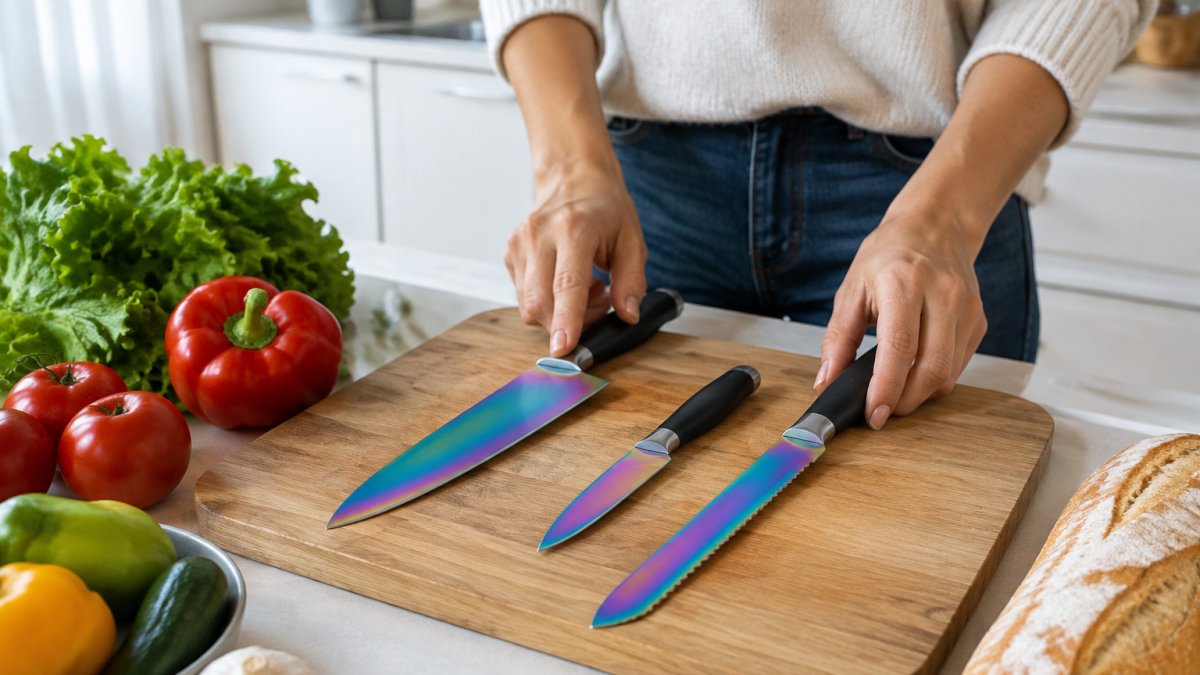
For most kitchens, three knives cover the majority of tasks: a chef's knife for chopping, slicing, and dicing; a paring knife for small precision work such as peeling and trimming; and a bread knife for crusty loaves and delicate slicing. A utility knife and a santoku knife add flexibility for vegetables and smaller cuts, and a steak knife set matters mainly if you serve whole cuts at the table. Specialty knives, boning, fillet, cleaver, carving, are worth adding only when you cook the dishes that call for them.
Watch out: a large block with many specialty knives can crowd your counter without improving your cooking, and the extra pieces often go unused while the chef's knife does most of the work. Choose the pieces you will use weekly, not the ones that fill a box.
The SiliSlick® Kitchen Knife Set Kit is a good example of a set built around essentials rather than filler. It includes an 8-inch chef knife, an 8-inch bread knife, a 7-inch santoku knife, a 5-inch utility knife, and a 3.5-inch paring knife, which covers the core tasks well and leaves room for a magnetic rack and sharpener instead of redundant blades. You can compare that configuration against other options in the full knife sets range.
Set size should follow cooking style. Beginners and occasional cooks usually do best with a five-piece set that covers the essentials and includes storage. Frequent cooks who prep daily may want the same core plus a santoku or utility knife for vegetables. Entertaining households often add steak knives, which is why a bundle such as the Kitchen Knife Set & Steak Knife Bundle can make sense. Professionals and serious enthusiasts tend to buy individual blades they can sharpen and replace, which is where a premium single knife like the Damascus VG10 Chef Knife fits better than a large block.
A simple rule: if you cannot name the task a knife in a set will handle in your kitchen, you probably do not need it. Build your set around the three essentials first, add one or two flexibility pieces, and treat everything else as optional.
Choosing Your Kitchen Knife Set and Next Steps
Start by listing the tasks you do most often, then pick the set whose knives match those tasks. Check the storage you have, since a magnetic rack suits small kitchens while a block suits counter-heavy setups. Compare the price, piece count and included accessories before you decide.
Ready to choose? Our Kitchen Knife Set Kit with its red magnetic rack and portable sharpener is a colorful option at $29.00, and the full SiliSlick® knife set collection lets you compare every configuration side by side. Shop today at SiliSlick® and find the set that fits your kitchen.
Frequently Asked Questions
Are any kitchen knives made in the USA?
Yes. Several American knifemakers produce kitchen knives in the United States, though most knives sold in the US are still manufactured overseas. Domestic production is typically smaller in scale and often reflected in higher prices. Checking the maker's stated manufacturing location, and whether the blades and handles are produced domestically, is the surest way to confirm an American-made claim before buying.
What is the best American-made kitchen knife set?
The best choice depends on how you cook and what you spend. SiliSlick's Kitchen Knife Set Kit with Black Magnetic Rack and Sharpener is listed at $29.00 and includes five knives, a magnetic rack and a sharpener. Its listing does not state a manufacturing country, so verify origin with the seller before assuming a US-made claim. Compare set contents, blade steel and warranty terms side by side before deciding.
What should I look for when buying a USA-made knife set?
Start with the manufacturing claim: does the company state where the blades are forged or ground, and where the handles are assembled? Next, check the set contents so you are not paying for knives you will never use. Review blade steel, handle construction and the warranty. Finally, confirm how the set is sharpened and maintained, since sharpening and repair costs add up over years of use.
Are American-made kitchen knives worth buying?
They can be, particularly if you value domestic craftsmanship and want to know where your knives were made. Expect to pay more than mass-produced imports for comparable blade quality. For budget-conscious buyers, a smaller set of well-chosen knives often delivers more everyday value than a large set with knives you rarely use. Decide based on how often you cook and which knives you reach for most.
