

Quick Summary
The best ergonomic kitchen knife handles for arthritis are thick, contoured or angled designs that spread grip force across the palm and keep the wrist neutral. Choose a handle that fits your grip span, test it with a real vegetable, and pick a sharp, smooth-edged blade to reduce the pressure needed to cut.
- Handle shape matters more than blade shape for arthritic hands, according to the article.
- A handle diameter between 1.0 and 1.25 inches fits most adult hands.
- Hold a knife for two minutes while pretending to chop to fit-test it.
- Sharpness reduces cutting effort more than almost any other single factor.
- Store knives on a magnetic rack to avoid lifting them from a block.
Table of Contents
- Why Handle Shape Matters More Than Blade Shape for Arthritic Hands
- How to Compare Handle Shapes and Grip Styles
- Best Kitchen Knives for Arthritis: Five Ergonomic Options from SiliSlick®
- Steak Knives With Ergonomic Handles for Easier Cutting
- Adaptive Kitchen Knives and Rocker-Style Alternatives
- Arthritis-Friendly Kitchen Tools Beyond the Knife
- Choosing Your First Ergonomic Knife: Fit Testing, Safety and Care
- Frequently Asked Questions
Why Handle Shape Matters More Than Blade Shape for Arthritic Hands
Last Updated: October 30, 2026
Most people with arthritis in their hands struggle less with the blade and more with the handle. A knife that feels fine in a young, strong grip can become painful within minutes when the knuckles are swollen or the fingers curl. At SiliSlick®, we design our knives around that problem, so the handle comes first, and our ergonomic kitchen knife handles are built for that purpose.
A handle that is too thin forces the fingers to pinch, which concentrates load on the joints. A wider, contoured handle spreads that load across the palm. Ergonomic kitchen knife handles for arthritis sufferers are built around this idea: more surface area, a neutral wrist, and less grip force needed to control the cut.
Blade shape matters too, but usually in a secondary way. A sharp, smooth-edged blade cuts with less pressure, which means less force from your hand. Sharpness reduces effort more than almost any other single factor.
How to Compare Handle Shapes and Grip Styles
Handle shape is the feature to compare first. Each style suits a different kind of pain or range of motion, and the differences are concrete enough to test before you buy.
The four handle families you will encounter
Thick, round handles. These spread grip force across the whole palm instead of concentrating it at the fingers. They work well when finger strength is limited, but a very thick handle can be hard to close your hand around if your grip span is small.
Contoured handles. These have finger grooves or an oval cross-section that follows the natural curve of a relaxed hand. They reduce pressure points during longer prep sessions, but they are less forgiving if your hand size falls outside the design range. Left-handed users should check that any contour is symmetric or available in a left-hand version.
Angled or upright handles. The blade sits at roughly a right angle to the handle, so you cut with your wrist in a neutral position rather than bent down. This is the design most often recommended when wrist flexion is painful. The trade-off is a different cutting motion that takes a few meals to learn.
Multi-grip handles. These are shaped so you can hold them in more than one position, choked up near the blade for control or back near the end for leverage. They suit people whose pain varies day to day, because you can change grip without changing knives.
Match the handle to your specific limitation
| Handle Style | How It Helps | Best For | Watch Out For |
|---|---|---|---|
| Thick, round handle | Spreads grip across the palm | Limited finger strength | Too-thick handles are hard to close around |
| Contoured handle | Fits the natural curve of the hand | Ongoing hand pain | May not fit unusual hand sizes; check left-hand options |
| Angled / upright handle | Keeps wrist neutral | Wrist flexion pain | Requires learning a new cutting motion |
| Multi-grip handle | Lets you change grip positions | Variable day-to-day pain | Less specialized than a dedicated design |
| Lightweight, balanced handle | Reduces wrist effort | Repetitive chopping | Too light can feel unstable for firm foods |
Fit-test criteria before you buy
When you test a knife in a store or at home, hold it the way you would while cutting and check these five things:
- Grip span. Your fingers should wrap around the handle with a small gap, not touch your palm, and not strain to reach.
- Wrist angle. Your wrist should stay straight, not bent up or down, when the blade meets the board.
- Pressure points. Run your thumb along the handle; you should not feel a hard ridge digging into any joint.
- Texture and slip. A slightly textured or rubberized handle is easier to hold with damp hands than a smooth, polished one.
- Weight and balance. A heavy knife can feel secure but tire the wrist faster; a balanced knife puts the weight near the bolster so the blade does more of the work.
A practical test: hold the knife for two minutes while pretending to chop. Discomfort during a simple grip test usually gets worse with real cutting. If you can, try before you buy or choose a retailer with a return policy that lets you test at home.
Best Kitchen Knives for Arthritis: Five Ergonomic Options from SiliSlick®
Here are the SiliSlick® knife sets we would recommend when comfort and control are the priority. Each set uses food grade stainless steel blades with a titanium coating and ergonomic handles.
1. Kitchen Knife Set - Green Handle ($25.00) This five-piece set includes a chef, bread, Santoku, utility and paring knife. The handles are designed for a secure, comfortable grip.
2. Titanium-Plated Kitchen Knife Set - Black Handles ($25.00) This set matches the green-handled set in blade sizes but uses black polymer handles.
3. Kitchen Knife Set Kit | Green Handle & Red Magnetic Rack ($28.00) This kit adds a magnetic rack, so you do not need to pull knives from a drawer.
Kitchen Knife Set - Green Handle →
4. Steak Knife Set of 4 - Titanium-Coated Smooth Blades ($16.00) Smooth, plain edges are designed for clean slicing through steak. Best for: a low-cost upgrade to your dinner table. Skip if: you need a full kitchen set.
5. Steak Knife Set 6 Rainbow Titanium Coated Blades & Blue Handles ($17.00) Six knives with blue ergonomic handles give a full table setting for guests. Best for: serving a group. Skip if: you only cook for one or two people.
Compare the sets in the table below before you choose.
| Set | Price | Pieces | Handle Color | Best For |
|---|---|---|---|---|
| Kitchen Knife Set - Green Handle | $25.00 | 5 | Green | Full daily prep |
| Titanium-Plated Kitchen Knife Set | $25.00 | 5 | Black | Full daily prep |
| Kitchen Knife Set Kit with Magnetic Rack | $28.00 | 5 + rack | Green | Organized storage |
| Steak Knife Set of 4 | $16.00 | 4 | Black | Dinner table |
| Steak Knife Set 6 Blue Handles | $17.00 | 6 | Blue | Entertaining |
Steak Knives With Ergonomic Handles for Easier Cutting
Steak is one of the hardest foods to cut with weak hands. The right steak knife reduces the force needed to get through meat.
Our steak knife sets use smooth, plain edges rather than serrations. The black-handled four-piece set and the red-handled six-piece set both use ergonomic handles designed for a comfortable grip.
Choose a set based on how often you use it. A four-piece set works for a small household. A six-piece set suits hosting. Each knife includes a protective safety sheath for storage.
Adaptive Kitchen Knives and Rocker-Style Alternatives
Some people find a standard straight-handled knife hard to control at any angle. Adaptive designs and rocker-style blades can help in those cases. A rocker-style blade has a curved edge that lets you cut with a back-and-forth rocking motion instead of a straight downward chop, which can reduce wrist movement.
Our sets are not rocker knives. For a rocking cutting motion, look for a dedicated rocker or adaptive knife elsewhere.
Arthritis-Friendly Kitchen Tools Beyond the Knife
A knife is only one part of food prep. The tools around it can ease strain as much as the knife does.
Consider these supporting tools:
- A stable cutting board with a non-slip base, so you do not have to hold food in place with force
- Lightweight pans and pots with wide, easy-to-grip handles
- A magnetic knife rack, so you lift knives with less effort
- Adapted jar openers and peelers with thick handles
Good tools work together. A sharp knife, a stable board and a comfortable grip reduce effort at every step.
Choosing Your First Ergonomic Knife: Fit Testing, Safety and Care
Start with a fit test. Hold the knife for two minutes while pretending to chop. Check that your wrist stays straight, your fingers do not cramp, and the handle does not slip when your hand is damp. If you can test with a real vegetable, do it, a carrot or potato reveals wrist angle and grip fatigue faster than an empty-hand test.
Safety protocols for limited dexterity
Reduced grip strength and hand pain change how you should handle a blade. These habits matter more than the knife itself:
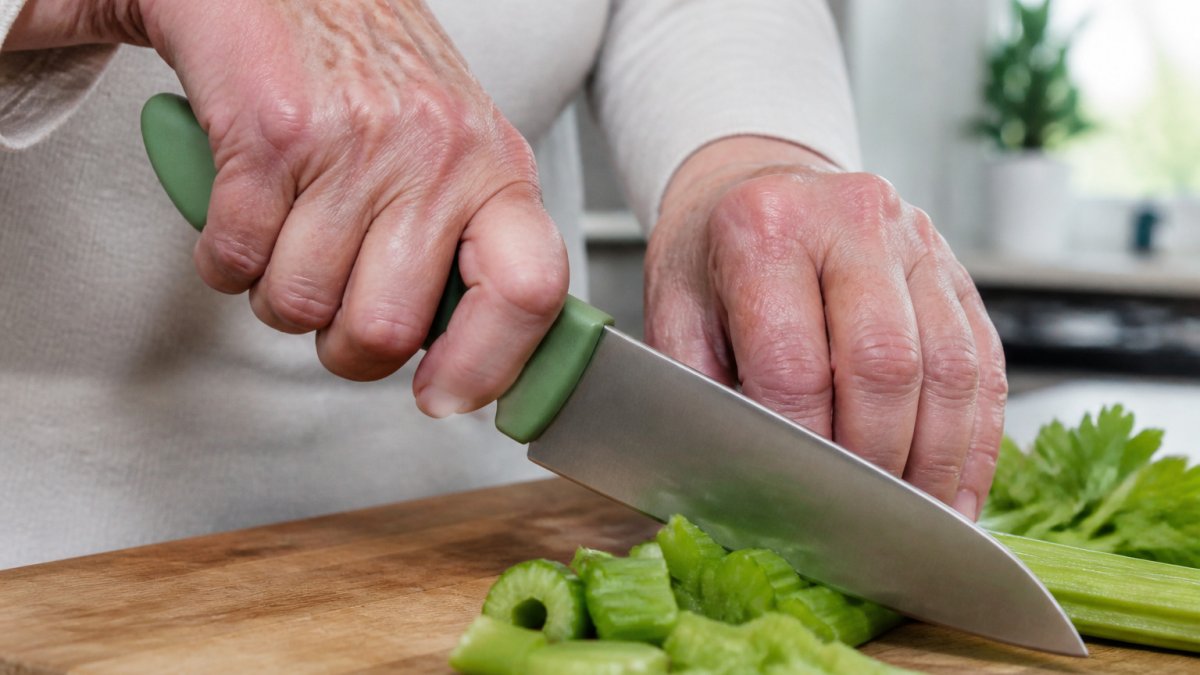
- Claw and pivot technique. Curl your fingertips under like a claw and rest your knuckles against the blade to guide it. The blade rides against your knuckles, not your fingertips. For rocking cuts, keep the tip on the board and pivot rather than lifting the whole knife.
- Non-slip surfaces. Place a damp towel or a silicone mat under the cutting board so it does not slide. A board that moves is a common cause of slips when grip is weak.
- Blade storage. Store knives in their sheaths, on a magnetic rack, or in a block, never loose in a drawer where you have to fish for them. A magnetic rack also removes the need to grip and lift a knife from a block, which can be hard on sore hands.
- Sharpening. Hone lightly before each use and sharpen on a schedule that matches how often you cook.
- Cleaning. Hand wash with mild detergent and dry right away. The steak knife sets are not dishwasher safe.
- Cutting technique. Keep the blade pointed away from your body, cut on a stable board, and never cut toward your hand. When a food is hard to hold, cut it in half first so it sits flat.
Frequently Asked Questions
What type of knife handle is best for arthritis?
A thick, rounded or multi-grip handle is usually easier on arthritic hands because it spreads pressure across the palm instead of pinching the fingers. The red-handled SiliSlick® steak knives have handles approximately 0.75 inches in diameter. Test the grip by closing your hand around the handle and checking whether your joints stay relaxed. Avoid thin, slick handles that force a tight pinch grip during long cutting sessions.
Are rocker knives easier to use with arthritis?
Rocker-style knives let you cut with a back-and-forth or rocking motion, so you can keep the tip on the board and use the body of the blade to slice. This often reduces the wrist and finger effort needed for chopping herbs or vegetables. The SiliSlick® Kitchen Knife Set - Green Handle includes a Santoku and a Chef knife. Rocker technique works best when paired with a handle that fits your grip, since the motion still depends on how comfortably you can hold the knife.
What features make a kitchen knife easier to grip?
Look for ergonomic handles with a contoured shape, a diameter that fills your palm, and a material that stays secure when your hands are damp. The SiliSlick® Kitchen Knife Set - Green Handle uses ergonomically designed handles built for a secure, comfortable grip during cutting tasks. Try each knife in a store or check the handle dimensions before you buy, and choose a size that suits the tasks you do most often.
Is a heavier or lighter knife better for arthritic hands?
A lighter knife generally causes less strain on the wrist and fingers during repeated cutting, but weight alone does not decide comfort. A balanced knife with a well-shaped handle can feel easier to control than a light knife with a poor grip. The SiliSlick® set includes a 3.5-inch paring knife, a 5-inch utility knife and an 8-inch chef knife. Choose the weight that lets you control the blade without gripping hard.
