

Table of Contents
- Damascus Steel Knives Worth It? The Short Answer
- What Damascus Steel Actually Is (and Why It Costs More)
- Edge Retention, Sharpness, and Rockwell Hardness Compared
- Real vs Fake Damascus Steel: How to Spot a Laser-Etched Imposter
- Benefits of Titanium-Coated Knives for Home Cooks
- How to Care for Damascus Steel Knives Without the Hassle
- SiliSlick Damascus Steel Knives: A Closer Look
- Conclusion: Who Should Buy Damascus Steel Knives?
- Frequently Asked Questions
Last Updated: September 30, 2026
Damascus Steel Knives Worth It? The Short Answer
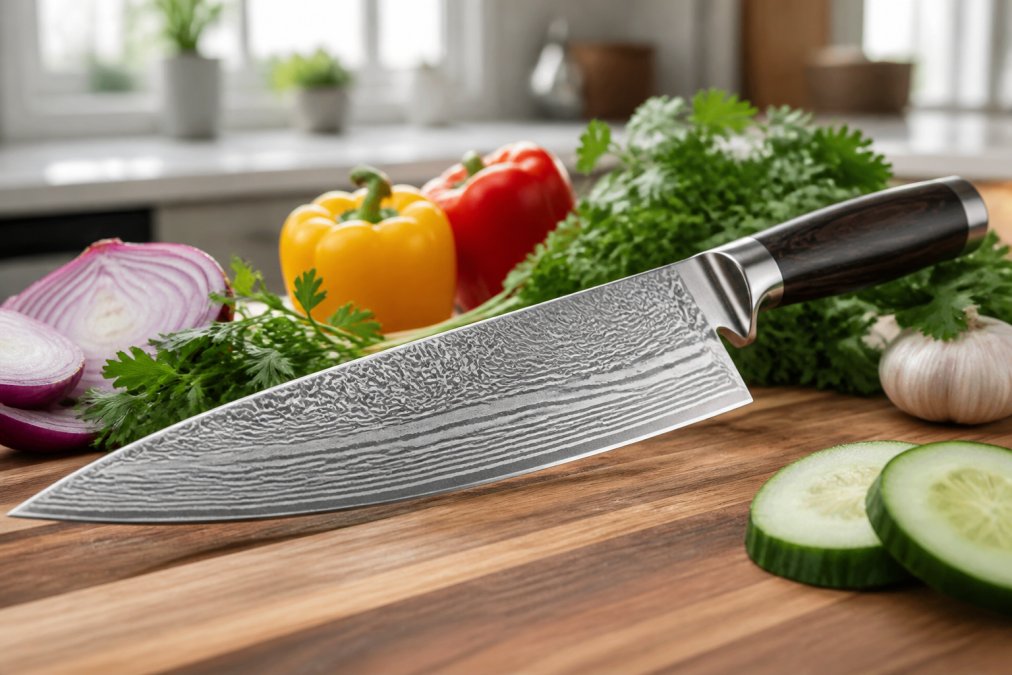
Are Damascus steel knives worth it? For most home cooks, yes, if you value edge retention, easy maintenance, and a look that stands out on the counter. Damascus steel knives are kitchen blades made from layered high-carbon steel, folded and forged so the layers create a visible wavy pattern along the blade. At SiliSlick®, we build ours from 67 layers of VG-10 Japanese steel with a 62+ Rockwell hardness core, and they start at $79.

The pattern is not just decoration: the layering affects performance and drives up the price.
What Damascus Steel Actually Is (and Why It Costs More)
Damascus steel is a layered metal blade formed by forge-welding two or more types of steel together, then folding and pattern-forming the billet so the layers remain visible after acid etching. The name comes from historical blades traded through Damascus, though the modern kitchen version is a different process entirely.
The cost comes from labor, not raw material.
Pattern-Welded vs. Crucible Steel: The Real Difference
Pattern-welded steel is made by stacking and forge-welding distinct steel layers, while crucible steel is melted in a crucible and allowed to form its own internal pattern as it cools. Modern Damascus kitchen knives are almost always pattern-welded. True crucible steel, sometimes called wootz, is a historical material and rarely appears in a retail kitchen knife.
Edge Retention, Sharpness, and Rockwell Hardness Compared
Edge retention is decided almost entirely by the core steel, not the visible outer layers. The cladding provides corrosion resistance and looks; the core's alloy chemistry and hardness set how long the blade stays sharp.
| Property | What it controls | Higher value means | Lower value means |
|---|---|---|---|
| Hardness (HRC) | Resistance to rolling and abrasion | Longer edge retention, more chip risk | Faster dulling, more toughness |
| Toughness | Resistance to chipping and cracking | Survives hard contact, dulls faster | Chips on bones or frozen food |
| Carbide volume | Wear resistance at the edge | Holds an edge in abrasive cutting | Wears faster on hard boards |
| Bevel angle | How the edge meets food | Thinner = sharper feel, weaker edge | Thicker = durable, wedges more |
How Blade Geometry and Micro-Serrations Affect Cutting
Blade geometry decides how a knife feels in the hand more than any spec sheet number. Our blades use a double bevel at 12-18 degrees per side, a thin, aggressive angle that slices cleanly through tomatoes and proteins.
Why 'Harder Is Better' Is the Wrong Rule
Many enthusiasts chase the highest HRC number they can find. In practice, a 64 HRC blade at 10 degrees per side will chip on a chicken bone where a 60 HRC blade at 15 degrees shrugs it off. The right hardness depends on what you cut and how you sharpen; for a general-purpose home chef's knife, 60-62 HRC at 12-18 degrees per side is a durable, sharp compromise, the range our VG-10 cores are built to.
Real vs Fake Damascus Steel: How to Spot a Laser-Etched Imposter
Real Damascus steel shows a pattern that continues into the steel itself, so the pattern stays visible on the spine, the bevel, and the area near the edge. Fake Damascus is laser-etched or printed onto a plain blade, so the pattern stops at the surface. This is the single most common way buyers get burned, and the difference is structural, not just visual.
The Structural Test: Where Does the Pattern Live?
A forge-welded billet is a solid block of alternating steel layers. When the blade is ground and acid-etched, the acid eats the layers at different rates because of their different carbon and alloy content, so the pattern is a three-dimensional feature of the steel.
Damascus Steel Chef’s Kitchen Knife →
That single difference produces every reliable tell:
- The spine test. Look at the top edge of the blade. On a real billet, the layers run all the way through, so the pattern continues across the spine. On a fake, the spine is plain steel because the etching only covered the flat face.
- The edge-proximity test. Look at the millimeter of steel just above the cutting edge. Real layers continue down to the bevel. Etching often fades or stops before it reaches the edge, because the manufacturer did not want the pattern to interfere with the grind.
- The bevel test. On a real blade, the pattern follows the bevel geometry and can look slightly distorted where the grind cuts across the layers. On a fake, the pattern sits flat and ignores the bevel.
- The repetition test. Real forging produces an organic, slightly irregular wave. If every knife in a product lineup shows a pixel-identical pattern, it was printed, not forged.
- The texture test. Run a fingernail across the pattern. Real layers are flush with the steel, the pattern is in the metal, not on it. A raised or flaking pattern is a coating.
The Price and Process Reality Check
Forge-welding a billet is labor-intensive. That labor is why genuine pattern-welded knives carry a real floor price; a 'Damascus' knife under $30 is almost always etched or printed.
A Quick Field Checklist
- Pattern continues across the spine
- Pattern reaches the area just above the cutting edge
- Pattern follows the bevel geometry
- Pattern varies from knife to knife in a lineup
- Pattern is flush with the steel, not raised
- Price is consistent with the labor of forge-welding
If a blade passes all six, you are almost certainly looking at genuine pattern-welded steel. If it fails two or more, the 'Damascus' label is marketing.
Benefits of Titanium-Coated Knives for Home Cooks
Titanium-coated knives solve a different problem than Damascus. The coating adds a hard, smooth surface that resists staining, speeds cleanup, and gives some knives their rainbow finish, a practical choice for home cooks who want a striking look without the maintenance a bare high-carbon blade demands.
How to Care for Damascus Steel Knives Without the Hassle
Caring for Damascus steel knives takes about 30 seconds per use. Wash by hand with mild detergent, dry immediately, and store the blade where it will not knock against other metal.
- Hand wash only, never dishwasher
- Dry the blade right after washing
- Store on a magnetic strip or in a block
- Hone lightly before each heavy prep session
- Sharpen on a whetstone at the factory angle, or send it out
SiliSlick Damascus Steel Knives: A Closer Look
Conclusion: Who Should Buy Damascus Steel Knives?
Buy Damascus steel knives if you cook often, want a blade that holds its edge, and care how your kitchen looks. Skip them if you want a knife you can toss in the dishwasher. The performance gain is real, but it comes with a small maintenance routine and a higher upfront cost.
Frequently Asked Questions
Do professional chefs use Damascus steel knives?
Many professional chefs use Damascus steel knives for their sharpness and edge retention, though it depends on the kitchen. The VG-10 steel core found in quality Damascus blades holds a 62+ Rockwell Hardness rating, which means it resists dulling through long prep sessions. That said, some chefs prefer simpler high-carbon stainless blades because they're easier to sharpen quickly during service. Damascus knives are most common in kitchens where presentation and precision matter as much as speed.
How much should a real Damascus knife cost?
Real Damascus steel knives made with a genuine VG-10 core and 67 layers typically start around $79 for a single chef's knife. Anything under $30 is almost always a laser-etched pattern on a plain stainless blade, not true forge-welded Damascus. The price reflects the labor of folding and welding multiple steel layers, plus the quality of the high-carbon core. A real Damascus knife is an investment that can last decades with proper care.
How can you tell if a Damascus knife is fake?
Fake Damascus knives usually have a pattern that looks printed or painted on rather than forged into the steel. Price is another clue, since genuine 67-layer VG-10 Damascus typically starts around $79 for a single chef's knife.
Does Damascus steel need to be oiled?
Damascus steel knives with a stainless VG-10 core don't require frequent oiling the way pure carbon steel blades do. However, applying a thin layer of food-safe mineral oil to the blade once a month helps protect the pattern-welded layers and keeps the Pakkawood handle from drying out. Always hand wash with mild detergent and dry immediately after use. Never put a Damascus knife in the dishwasher, since the heat and moisture can damage both the blade and the handle.
Is Damascus steel better than high-carbon stainless steel?
Damascus steel knives offer a striking appearance and good edge retention, but they cost more and need more careful maintenance. A Damascus blade with a VG-10 core at 62+ Rockwell Hardness stays sharp longer. High-carbon stainless is easier to sharpen and more forgiving if you leave it wet. If you want performance and visual appeal, Damascus is worth it. If you want low maintenance, stick with stainless.